Core architecture and memory fit
The LM3S1608-EQC50-A2T: Built around a 32-bit ARM Cortex-M3 core running at 50 MHz, this MCU delivers a deterministic interrupt response suited for control-loop applications where timing closure matters — the Cortex-M3 tail-chaining reduces ISR latency to 12 cycles, avoiding jitter in PWM or sensor-sampling routines. On-chip memory comprises 128 KB of flash (128K x 8) and 32 KB of SRAM (32K x 8) — enough to hold a moderate application stack and a real-time OS kernel with ~80 KB left for code after the HAL and driver overhead.
On-chip data conversion is handled by an 8-channel, 10-bit ADC — adequate for reading analog sensors like thermistors or potentiometers at sample rates typical of motor-control or instrumentation loops. Built-in brown-out detect/reset, POR, PWM, and a watchdog timer reduce external supervision ICs; the internal oscillator saves a crystal on the BOM when timing accuracy of ±1% is acceptable.
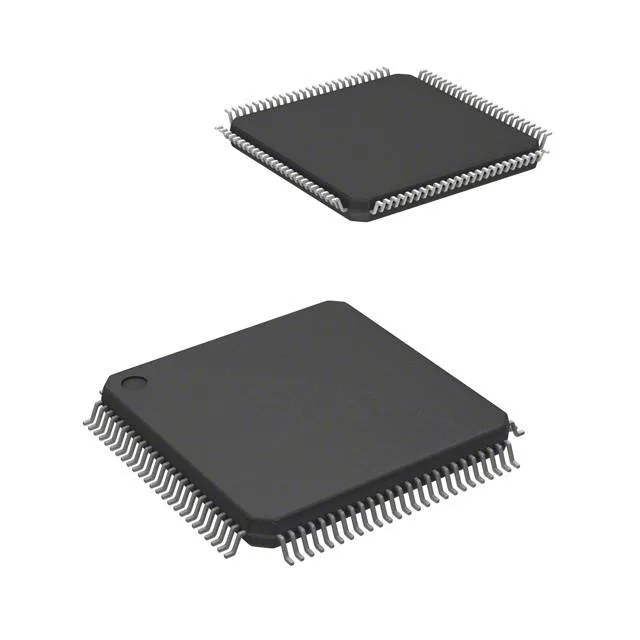
Housed in a 100-pin LQFP (14x14 mm body), the 0.5 mm pitch demands a 4-layer PCB for reliable fan-out of the inner rows — two-layer boards will struggle to route all 52 I/O plus the power and ground nets without via congestion.
The 100-LQFP footprint is common across the Stellaris family, but a board spin may be required if migrating to a different TI MCU series.