NRND — planning for the last-time-buy window
Texas Instruments lists the LM3S1512-IBZ25-A2 as NRND (Not Recommended for New Designs). This means the part is still available for existing production but is not intended for new board spins. The official lifecycle status signals that a last-time-buy window may be open or approaching — designs already using this MCU should secure sufficient inventory for the remaining production run. The Stellaris family has been superseded by the Tiva C Series, but those devices use a different package and peripheral map — a board re-spin is required for migration.
Core and memory — fit for control-loop firmware
The ARM Cortex-M3 core runs at 25 MHz, delivering enough throughput for sensor polling, PID loops, and fieldbus protocol stacks without external memory wait-states. The 96 KB on-chip Flash holds the application code and bootloader; the 64 KB SRAM leaves headroom for data buffers and stack in a typical industrial controller. The 58 GPIO pins map directly to discrete I/O for limit switches, relays, and status LEDs. Two 10-bit ADC channels handle analog inputs like potentiometers or 4-20 mA current loops with external signal conditioning.
On-chip connectivity includes I²C, SPI, SSI, UART/USART, IrDA, and Microwire — enough to interface with external EEPROM, temperature sensors, motor encoders, and serial displays. The QEI (Quadrature Encoder Interface) peripheral directly decodes incremental encoder signals for closed-loop motor position feedback without bit-banging GPIO. The brown-out detect and POR circuits ensure the core resets cleanly on power-up or supply dips.
Package and thermal envelope
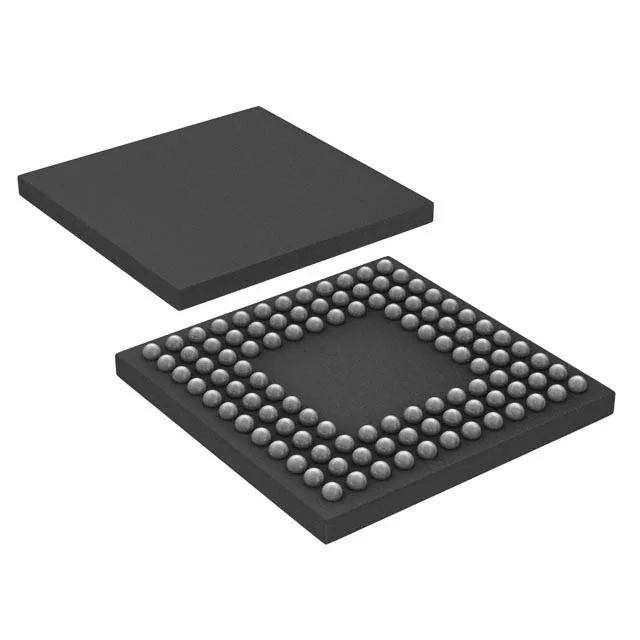
The 108-ball LFBGA package measures 10x10 mm with a 0.80 mm ball pitch — a standard four-layer PCB with via-in-pad can fan out all signals. The 2.5 V core supply keeps dynamic power lower than a 3.3 V part, which matters in thermally constrained enclosures.