25 MHz Cortex-M3 with 96 KB flash — memory headroom for the firmware
The LM3S1512-EQC25-A2: The 96 KB flash is the binding constraint for the application firmware; the 64 KB SRAM provides enough headroom for moderate data buffers and a real-time operating system heap. For a motor-control or sensor-fusion workload, the flash fills first — budget the code footprint before the BOM commit.
The 105°C ceiling covers outdoor enclosures, engine-bay electronics, and factory-floor panels without active cooling — the internal oscillator and flash retention are characterised across the full span. The 2.25 V to 2.75 V supply window is narrow; a 3.3 V rail needs an external LDO stepping down to 2.5 V, and the LDO's dropout and PSRR become part of the power budget.
100-LQFP package — board integration notes
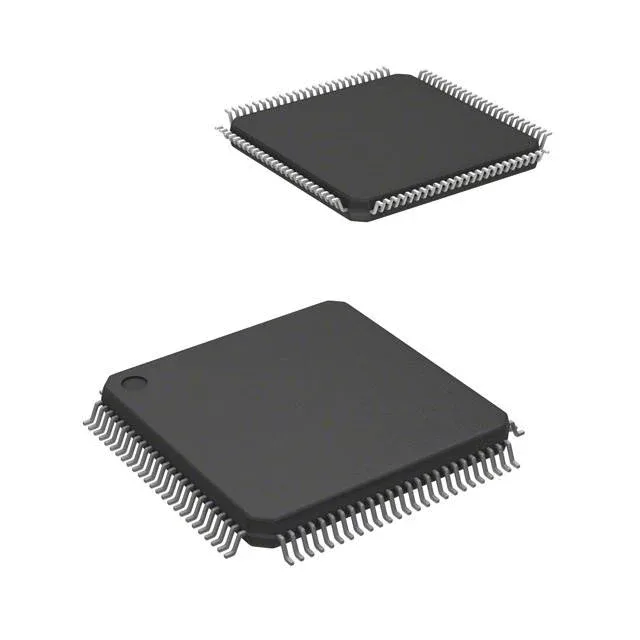
Housed in a 100-LQFP (14x14 mm, 0.5 mm pitch). The fine pitch forces a 4-layer PCB for fan-out — two-layer boards break out only the outer rows of pins. The exposed paddle at the package centre must be soldered to a thermal via array under the MCU; without it, the junction-to-ambient thermal resistance rises above the datasheet figure and the 105°C limit becomes harder to hold. The 58 general-purpose I/O are multiplexed with the peripheral set (I²C, SPI, UART, PWM, QEI), so pin assignment locks the available function mix.
Connectivity includes I²C, IrDA, Microwire, QEI, SPI, SSI, and UART/USART — enough serial interfaces for a multi-sensor node or a small drive controller. The QEI (quadrature encoder interface) is specific to motor-feedback applications; the PWM module with brown-out detect and watchdog timer covers the basic safety monitoring for an unregulated power source. The 2x10-bit ADC (two converters, 10-bit resolution) samples analog feedback at moderate rates — suitable for current sensing or potentiometer position, not high-speed data acquisition.
Obsolete — sourcing through independent surplus channels
Texas Instruments lists the LM3S1512-EQC25-A2 as Obsolete. For a BOM line that depends on this MCU, a board spin to a current-generation Cortex-M4 or M0+ part is the long-term migration path; the Stellaris family was superseded by the Tiva and MSP432 lines, neither of which is pin-compatible.