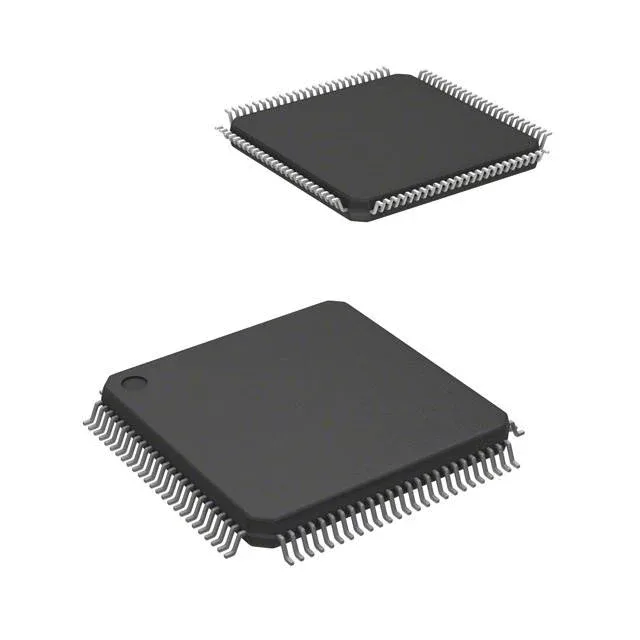
Texas Instruments has marked the LM3S1439-IQC50-A2 as Obsolete.
Core and memory profile
Built around the ARM Cortex-M3 core, the LM3S1439 runs at 50 MHz — a throughput sweet spot for control-loop and sensor-fusion tasks that don't need the overhead of a Cortex-M4 FPU. On-chip memory consists of 96 KB of Flash and 32K x 8 of SRAM. The Flash is sufficient for a moderate application stack plus a bootloader; the SRAM leaves room for a real-time OS heap and data buffers without external memory.
I/O, connectivity, and on-chip peripherals
52 general-purpose I/O lines provide enough pinout for a keypad, display interface, and several sensor inputs without a port expander. Connectivity options include I²C, IrDA, Microwire, QEI, SPI, SSI, and UART/USART — covering common serial buses for industrial sensors, motor encoders, and human-machine interfaces. On-chip peripherals include a brown-out detect/reset, POR, PWM, and watchdog timer. A 4-channel 10-bit ADC handles analog inputs like potentiometers or temperature sensors without an external converter.
Package and temperature grade
Housed in a 100-LQFP package with a 14x14 mm body, the device is suited for surface-mount assembly on standard FR-4 boards. The 0.5 mm pitch requires a controlled solder-paste stencil and a reflow profile typical for LQFP packages.
Supply voltage and system integration
The core and I/O operate from a single 2.25 V to 2.75 V supply. This narrow range simplifies the power rail design — a single 2.5 V LDO or a buck converter set to 2.5 V is sufficient, avoiding multiple regulators.