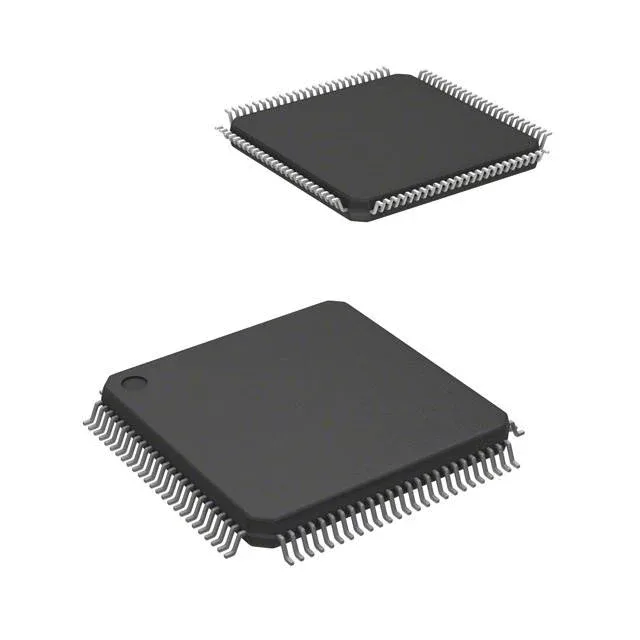
The LM3S1435-IQC50-A2T is a Stellaris® ARM® Cortex®-M3 MCU clocked at 50 MHz, with 96 KB of on-chip Flash and 32 KB SRAM. That Flash-to-SRAM ratio is typical for a control-oriented MCU — the firmware fits the application stack and a moderate communication library, but leaves headroom for field-upgradeable parameter tables. The 32-bit Cortex-M3 core at this speed delivers deterministic interrupt latency for time-critical loops like PWM generation or sensor polling.
Serial connectivity and ADC – sizing the peripheral mix
The two 10-bit ADC channels are adequate for single-ended analog inputs like potentiometer feedback or temperature monitoring; for more channels or higher resolution, an external ADC would be needed. Brown-out detect, POR, PWM, and WDT are integrated, reducing external supervisor IC count.
NRND status – procurement posture and migration planning
For new designs, a pin-compatible successor in the same Stellaris family should be evaluated — the 100-LQFP footprint and 2.25 V to 2.75 V supply rail are common across the series, so migration may be a firmware re-spin rather than a board respin.
Package and temperature grade – board-fit checklist
Housed in a 100-LQFP with a 14×14 mm body, the 0.50 mm pitch demands a controlled impedance board stack — a 4-layer PCB is the practical minimum for fan-out of all 46 I/O plus supply and ground. Supply voltage is 2.25 V to 2.75 V — a tight window that calls for a regulated rail; do not feed this from an unregulated battery or a 3.3 V bus without a low-dropout regulator.