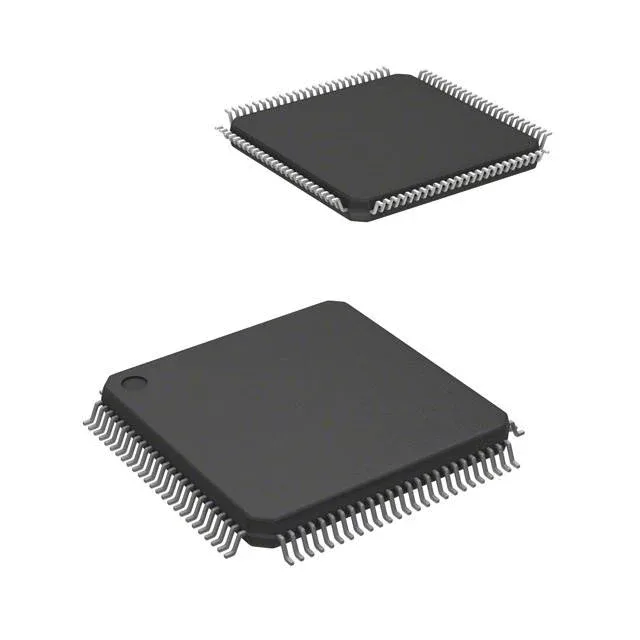
50 MHz Cortex-M3 with 64 KB Flash — what the memory means for your firmware
The LM3S1166-IQC50-A2T is a Stellaris ARM Cortex-M3 MCU from Texas Instruments, clocked at 50 MHz with a 32-bit single-core processor. That 50 MHz ceiling sets the instruction throughput — at one cycle per instruction for many Cortex-M3 operations, you get roughly 50 MIPS before memory wait states enter the picture. On-chip memory is split into 64 KB of Flash (64K × 8) and 16 KB of SRAM (16K × 8). The Flash holds the application code and constant data; the 16 KB RAM is the working buffer for stack, heap, and runtime variables. For a control loop logging sensor data at 100 Hz, that RAM budget accommodates roughly 4000 32-bit readings before needing external storage.
43 general-purpose I/O pins are available in the 100-LQFP package. That count is enough to drive a parallel LCD data bus (8 or 16 bits), read a row of pushbuttons, and still leave pins for serial interfaces. Serial connectivity includes I²C, SPI, SSI, UART/USART, and IrDA — the UARTs handle RS-232 or RS-485 transceivers for industrial comms, while the I²C and SPI buses connect to external ADCs, DACs, or EEPROMs without consuming extra GPIO. A 4-channel 10-bit analog-to-digital converter is built in, sampling at the MCU's internal clock rate. For applications that need to read a potentiometer, a thermistor, or a current-sense resistor, this ADC avoids an external converter — though the 10-bit resolution (1024 steps) limits precision to about 0.1% of the reference voltage.
Supply and temperature — the operating envelope
The core and I/O share a single supply rail: 2.25 V to 2.75 V. This qualifies the part for factory-floor enclosures, outdoor telecom cabinets, and automotive cabin applications (though it lacks AEC-Q100 certification).
Texas Instruments lists the LM3S1166-IQC50-A2T as Obsolete. The part is no longer manufactured or supported by TI for new designs.