50 MHz Cortex-M3 with 64 KB flash — the processing and memory budget
The LM3S1138-IBZ50-A2: That flash holds the application firmware plus a bootloader; the SRAM covers the stack, heap, and data buffers. For a typical sensor-node or motor-control firmware compiled from C, 64 KB flash supports a moderate RTOS (FreeRTOS or TI-RTOS) plus the application logic, while 16 KB SRAM leaves room for a few hundred bytes of global state and a double-buffered communication packet. The 2.25 V to 2.75 V supply rail means this MCU needs a regulated 2.5 V rail — not a direct battery connection. A 3.3 V system requires an LDO or a small buck converter to step down to the 2.5 V core supply.
Texas Instruments lists the LM3S1138-IBZ50-A2 as NRND (Not Recommended for New Designs). This means the part is still available for existing production but is not intended for new projects. For an existing BOM that already carries this MCU, sourcing through independent distribution is the practical path.
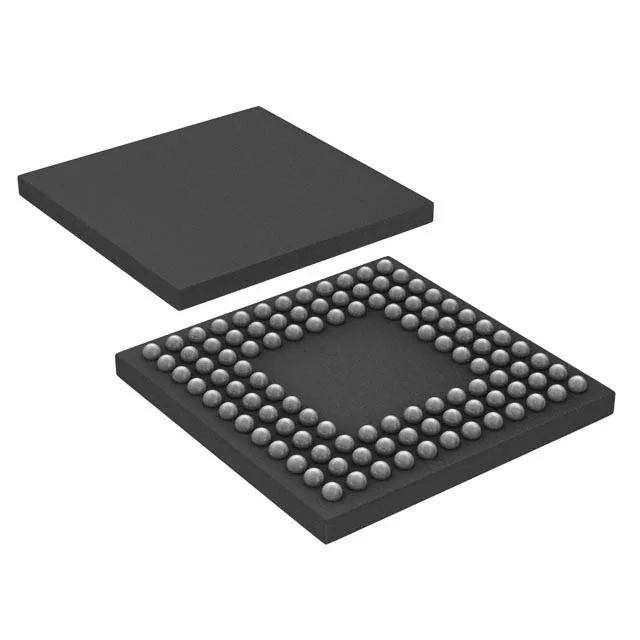
108-BGA footprint and board integration
The 108-ball BGA (10x10 mm body) uses a 0.80 mm ball pitch — standard for a 4-layer PCB with via-in-pad or dog-bone fan-out. The 46 GPIOs route to the outer ball rows, so the inner balls carry power, ground, and the core supply. A 2.5 V rail decoupled with a 10 µF ceramic plus 0.1 µF per supply ball pair keeps the core noise below 50 mV peak-to-peak. The industrial temperature range (-40 °C to 85 °C) qualifies the MCU for factory-floor controllers, outdoor telemetry gateways, and HVAC equipment — any environment where the ambient air temperature cycles through freezing and hot summer conditions.
Peripheral set for embedded control
On-chip peripherals include a 10-bit ADC with 8 multiplexed channels, PWM outputs, a watchdog timer, brown-out detect, and POR — enough to run a closed-loop motor drive or a sensor hub without external analog or supervisory ICs. The connectivity block covers I²C, SPI, SSI, UART/USART, IrDA, and Microwire, so the MCU can talk to serial EEPROMs, temperature sensors, LCD modules, and radio transceivers on the same board. For precision timing (CAN, USB, or high-frequency PWM), an external crystal or oscillator is still recommended.