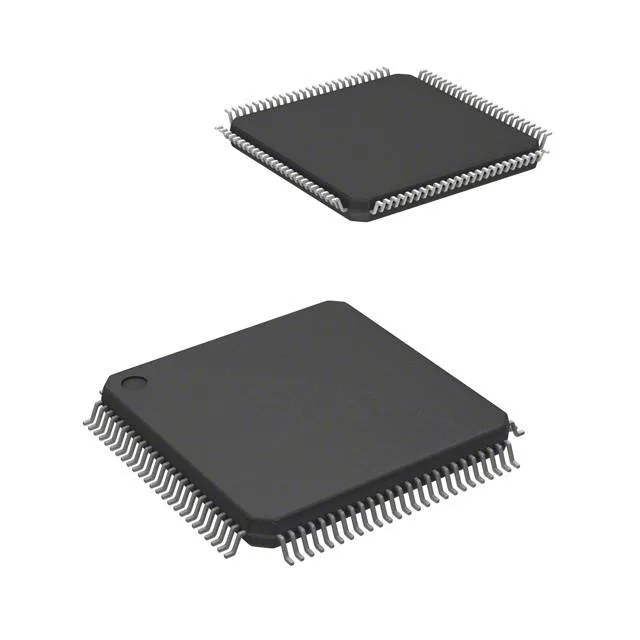
Texas Instruments has marked the LM3S1133-EQC50-A2 as obsolete. No pin-compatible direct replacement exists from TI; a board-level redesign to a current Cortex-M3 or Cortex-M4 part is the migration path for new production.
The LM3S1133-EQC50-A2 runs a 32-bit ARM Cortex-M3 core at 50 MHz. On-chip memory consists of 64 KB of Flash and 16 KB of SRAM. For a control-loop application with a moderate stack and a few KB of data buffers, the 16 KB RAM leaves room for the HAL and RTOS footprint — but a firmware image that approaches the 64 KB Flash ceiling will need code-size optimization or a move to a larger part. The 2.25 V to 2.75 V supply rail means this MCU runs from a 2.5 V rail, not the common 3.3 V — the regulator choice and decoupling plan must account for this.
Industrial temperature grade and 100-LQFP package
The 44 general-purpose I/O cover a typical sensor-and-actuator interface: a dozen digital inputs, a dozen outputs, plus the serial bus pins.
The Stellaris Cortex-M3S 1000 series peripheral set includes I²C, SPI, SSI, UART/USART, IrDA, and Microwire serial interfaces — enough to talk to common sensor modules, serial Flash, and industrial protocol ASICs. On-chip data conversion comes from two 10-bit ADC channels. Built-in brown-out detect, POR, PWM, and a watchdog timer reduce external supervisor IC count. The internal oscillator saves a crystal on boards where ±1% accuracy is acceptable, though a precision clock source is still needed for UART baud-rate tolerance at higher speeds.