NRND — what it means for the BOM line
Texas Instruments lists the LM3S1110-IBZ25-A2T as NRND (Not Recommended for New Designs). This is not an immediate EOL — the part remains available for existing production runs, but TI will not support it in new board spins.
Core and memory — the 25 MHz Cortex-M3 envelope
The ARM Cortex-M3 core runs at 25 MHz — a modest throughput ceiling suited for control-loop and sensor-fusion tasks that do not need the higher clock rates of later M4 or M7 parts. On-chip memory is 64 KB of flash and 16 KB of SRAM (organized as 16K x 8). For a typical firmware image with a small RTOS and application stack, budget roughly 20–30 KB for the code and 4–8 KB for runtime data; the remaining flash and RAM cover moderate peripheral buffers and lookup tables.
108-ball BGA — board-fit checklist
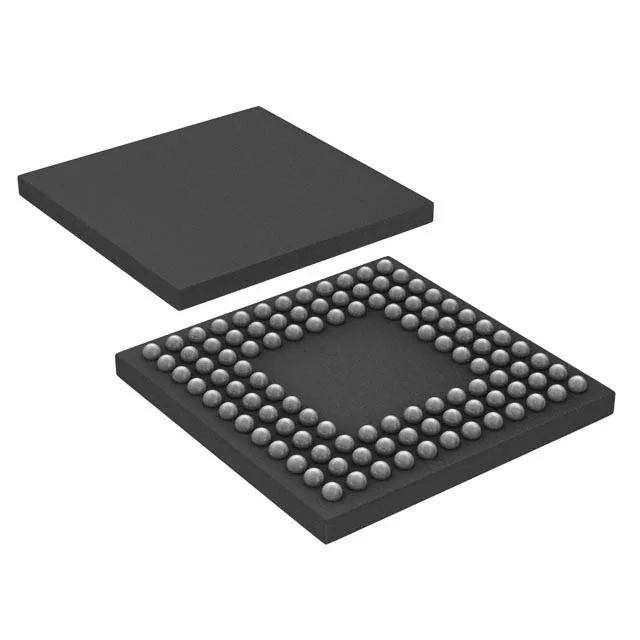
The LM3S1110-IBZ25-A2T comes in a 108-ball LFBGA, supplier package 108-BGA (10x10 mm). The 0.80 mm ball pitch is manageable on a standard 4-layer PCB with via-in-pad or dog-bone fan-out. The supply rail is a single 2.25 V to 2.75 V — no separate core and I/O voltages, which simplifies the power tree but means the entire MCU drops out if that rail dips below 2.25 V.
Peripherals and I/O — what the 41 pins connect to
The MCU exposes 41 general-purpose I/O lines and a peripheral set that includes UART/USART, SPI, SSI, Microwire, and IrDA connectivity — enough for serial communication with sensors, displays, and legacy industrial interfaces. On-chip peripherals include brown-out detect/reset, POR, PWM, and a watchdog timer, which cover the basic supervisory and timing needs of a standalone controller without external supervisor ICs.