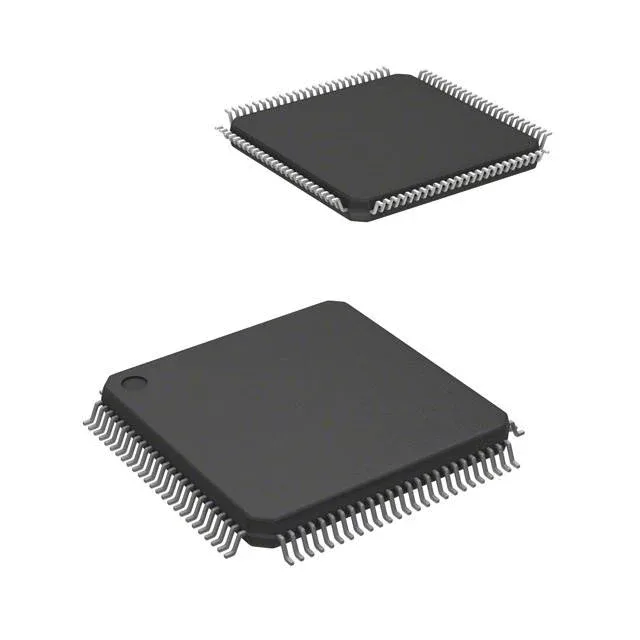
The LM3S1110-EQC25-A2: Typical applications include motor control, industrial sensors, and embedded control boards where a low-power Cortex-M3 core with a mature peripheral set is sufficient.
At 25 MHz the Cortex-M3 core runs with zero-wait-state Flash access for most linear code, but branching or tight loops that cross a Flash boundary may introduce a single wait state. The 16 KB RAM is sized for moderate data buffers and stack — enough for a UART command parser or a sensor fusion loop, but tight if you are running a TCP/IP stack without external memory. The 41 I/O lines come in a 100-pin LQFP, so plenty of pins are available for parallel LCD or memory interfaces, though the part lacks an external bus controller.
The LM3S1110 integrates UART/USART, SPI, SSI, Microwire, and IrDA interfaces, plus a PWM module, watchdog timer, and brown-out detect/reset. The UART count is not explicitly stated in the brief, but the connectivity list suggests at least one full-duplex UART with IrDA support.
No direct TI replacement order code is provided in the available records. The Stellaris family was acquired by TI from Luminary Micro and has been largely superseded by the Tiva C series, but pin-compatibility is not guaranteed without a cross-reference check.
The exposed pad is not present on this package variant, so thermal dissipation relies on the leadframe and board copper.