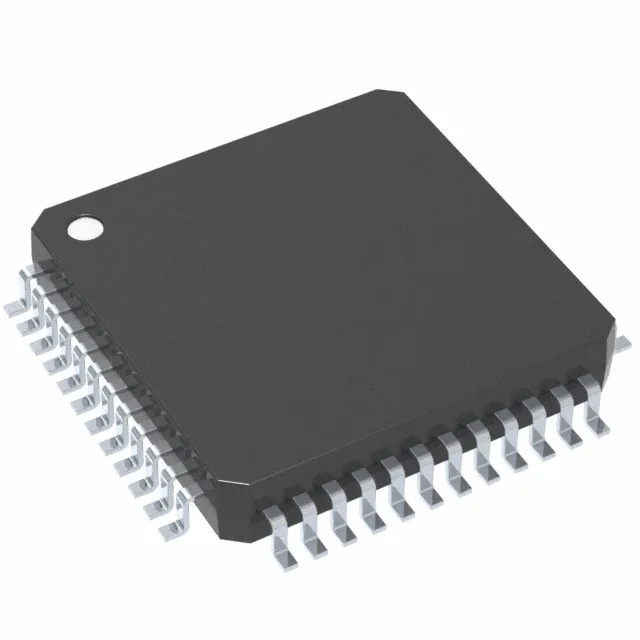
20 MHz Cortex-M3 with 8 KB flash — the firmware budget is the real constraint
The LM3S102-IQN20-C2 is a Texas Instruments Stellaris ARM Cortex-M3S 100 series MCU running at 20 MHz with 8 KB flash and 2 KB RAM. That 8 KB program memory is the headline constraint — it forces a tight firmware fit, especially once the HAL and any communication stack are linked. The 2 KB SRAM (2K x 8) leaves room for a modest call stack and a few ring buffers, but anything beyond a single UART or SPI transaction buffer starts eating into the flash for constants. The 20 MHz core speed is adequate for polling loops and interrupt-driven I/O at sub-1 kHz rates, but the flash wait-state profile at this frequency means instruction fetch stalls are minimal — the Cortex-M3 pipeline stays fed without the penalty seen at higher clocks on the same process node.
Industrial temperature grade and peripheral set — board-level integration
The 3V to 3.6V single supply rail simplifies the power tree — one LDO or buck converter feeds both the core and I/O, no separate VDDIO plane needed. On-chip peripherals include I²C, SPI, SSI, and UART/USART interfaces — enough for a temperature/humidity sensor (I²C), a serial flash (SPI), and a Modbus RTU link (UART). The 18 GPIO pins in the 48-LQFP package leave 12-14 usable after the serial interfaces are assigned, which constrains the number of discrete inputs and LED indicators. The PWM and WDT handle motor speed control (low-end DC brushed) and firmware watchdog recovery — both are standard for small-pump or fan-control applications.
The 48-LQFP (7x7 mm) package is a common footprint with wide second-source availability for pin-compatible Cortex-M3 parts from other vendors, though no official TI cross-reference is published for this specific order code.