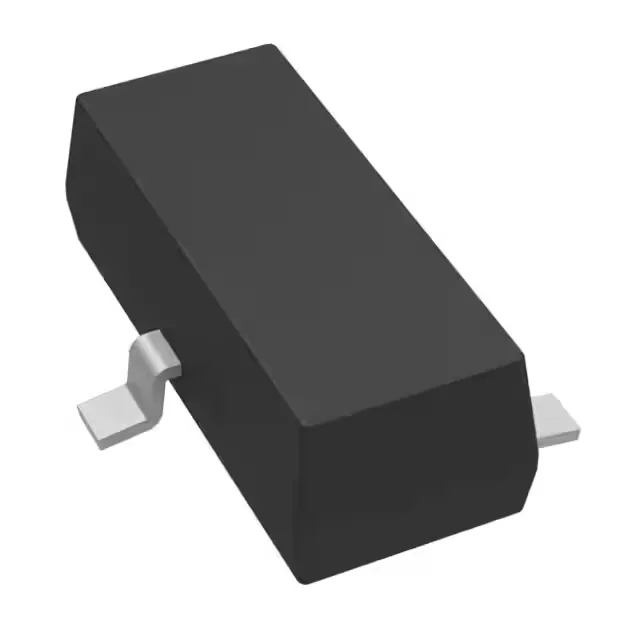
2.5V shunt reference in a SOT-23-3 — what it does
The LM385M3-2.5 is a fixed 2.5V shunt voltage reference from Texas Instruments, housed in a SOT-23-3 surface-mount package. As a shunt (two-terminal) reference, it behaves like a precision Zener diode: a series resistor sets the bias current, and the device regulates the output voltage by shunting current to ground. The output is fixed at 2.5V with a ±3% tolerance, and the reference draws a minimum cathode current of 15 µA to maintain regulation. Typical applications include portable battery-powered equipment, data-acquisition systems, and instrumentation where a low-power, low-cost voltage reference is needed.
Noise and temperature drift — the real-world limits
For a 2.5V reference, that is about 48 ppm of the output — adequate for 10- to 12-bit ADC references but marginal for 16-bit systems without averaging. The temperature coefficient is 150 ppm/°C, which means the output can shift by roughly 3.75 mV over the full 0°C to 70°C range. The shunt topology means the reference's power dissipation is the product of the output voltage and the total current flowing through it (load current plus cathode current). With a 20 mA maximum output current, the SOT-23-3 package can handle the thermal load in most low-power designs, but the designer must ensure the series resistor is sized to keep the total current within the 20 mA limit under all load conditions.
NRND — plan your BOM transition
The LM385M3-2.5 carries a Not Recommended for New Designs (NRND) status. This means Texas Instruments continues to manufacture the part for existing designs, but new projects should select an alternative.