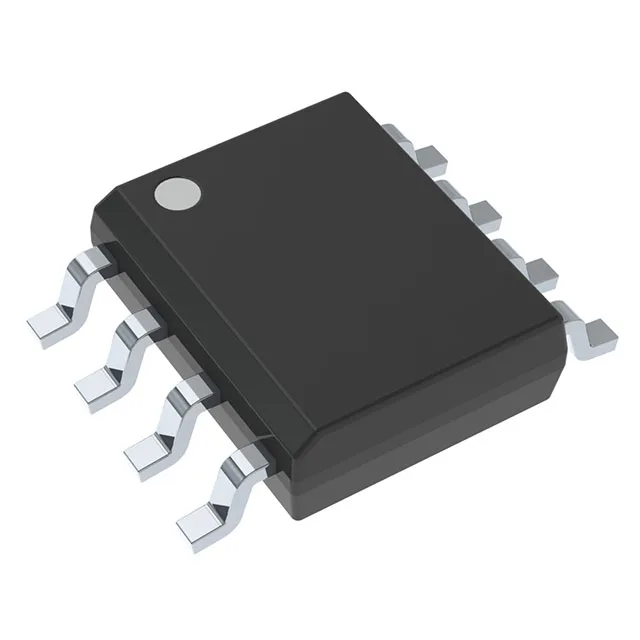
Dual general-purpose op-amp in 8-SOIC — the LM358BIDR
Each amplifier draws 300 µA, keeping the total quiescent current to 600 µA for both channels.
The 3 V minimum supply span lets this part run from a single lithium cell or a 3.3 V regulated rail, while the 36 V maximum covers 24 V industrial buses with margin. That wide compliance means the same BOM line can serve a 5 V sensor conditioner and a 24 V motor-current sense amplifier, reducing line-item count. The trade-off is the bipolar input stage: input bias current of 10 nA is higher than a CMOS-input op-amp, so high-impedance sources (> 1 MΩ) will see a noticeable voltage drop across the source resistance. For circuits with source impedances under 100 kΩ, the LM358BIDR is a straightforward fit.
1.2 MHz GBW and 0.5 V/µs slew — what the bandwidth buys you
The 1.2 MHz gain-bandwidth product supports closed-loop gains up to 100 with a 12 kHz bandwidth, adequate for audio-frequency filtering, slow servo loops, and DC measurement. The 0.5 V/µs slew rate limits large-signal response: a 10 V output step slews in 20 µs, so fast pulse amplification or high-frequency sine waves above 20 kHz will show distortion. For those applications, a higher-slew device like the TLV9362IDDFR (25 V/µs) would be the correct choice. The LM358BIDR is at home in signal conditioning, active filters below 10 kHz, and comparator-like threshold detection where speed is not critical.
It does not carry AEC-Q100 automotive qualification, so it is not a direct fit for under-hood or chassis-domain electronics without additional qualification testing.