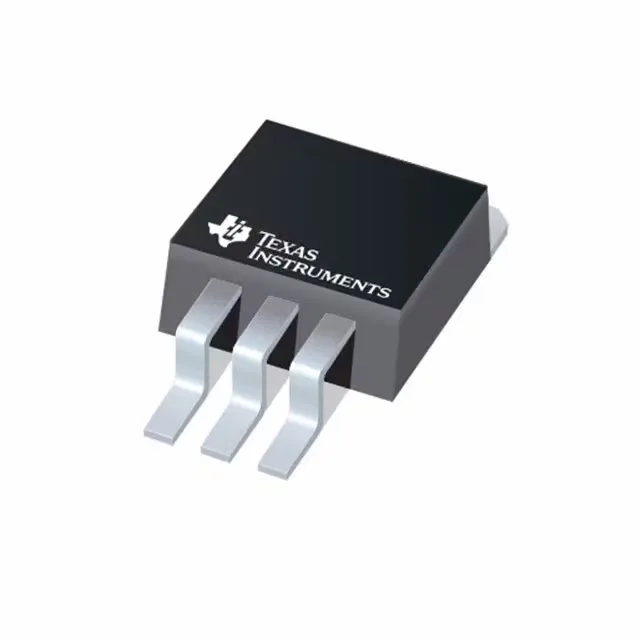
5V rail for analog and logic — what the 1.5A rating buys you
The LM340T-5.0/LF01 is a fixed 5V positive linear regulator from Texas Instruments, delivering up to 1.5A continuous output. That 1.5A ceiling means it can power a mixed-signal board with a few op-amps, an MCU, and some logic without needing a separate 3.3V rail — the 5V bus handles the analog front-end and the 5V-tolerant logic together. The 35V maximum input gives you headroom on common rails — a 12V supply leaves 30V of dropout margin, and a 24V industrial bus still has 11V of room before the regulator hits its limit. The 2V dropout at 1A is the real constraint: your input must stay above 7V to hold 5V regulation at full load.
PSRR at 120 Hz — why that number matters on a rectified rail
The 80dB PSRR at 120Hz is the spec that tells you how well this regulator cleans up ripple from a full-wave rectified mains supply. 120Hz is the fundamental ripple frequency from a 60Hz line after bridge rectification — 80dB of rejection knocks a 1V peak-to-peak ripple down to 100µV at the output. That is clean enough for a 12-bit ADC reference rail or a sensitive analog front-end without a post-filter. The 8 mA quiescent current is the regulator's own draw — it does not come out of the 1.5A load budget, but it does add to the thermal dissipation at high input-output differential. At 24V in and 5V out at 1A, the 19V drop times 1A plus the 8 mA Iq gives about 19W of heat to sink — the TO-263 D²Pak exposed tab is designed for that, but the PCB copper area and airflow need to be part of the thermal calculation.
Package and board-fit — TO-263 D²Pak with the exposed tab
The TO-263-4 (D²Pak) surface-mount package has three leads plus the exposed tab — the tab is the thermal path and is electrically connected to ground (output). A 2x2 inch copper area on a 2-layer board with no forced air is marginal at 1.5A with high dropout — budget a thermal simulation or at least a thermocouple check on the first prototype. The over-temperature and short-circuit protection are built in — the regulator shuts down if the die exceeds the thermal limit, and the current-limit circuit folds back the output if the load tries to pull more than the rated 1.5A. That means you do not need an external crowbar or a series fuse for the regulator itself, though the upstream power supply should still be fused for the full input current.
Active lifecycle and compliance — no obsolescence worry
No stock-holding claim; each BOM quantity is quoted individually.