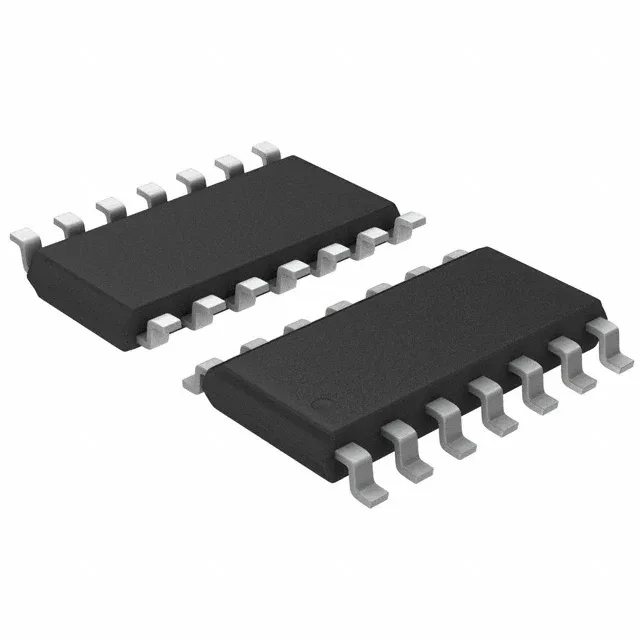
It packs four independent op-amp circuits into one 14-SO body, each with a 1.2 MHz gain-bandwidth product and a 0.5 V/µs slew rate. The supply range spans 3 V to 30 V single supply or ±1.5 V to ±15 V dual supplies, making it a drop-in for 5 V, 12 V, and 24 V board-level signal conditioning — sensor buffers, active filters, comparator functions, and DC gain stages where speed is secondary to flexibility.
The 1.2 MHz gain-bandwidth product sets the usable closed-loop gain bandwidth: at a gain of 10, expect a -3 dB point around 120 kHz. That is fine for DC measurement, audio-frequency filtering, and slow control loops, but it will round off fast edges in pulse-width modulation or high-speed comparator applications. For a 20 nA input bias current and 3 mV typical input offset, the DC precision is adequate for general-purpose work but not precision instrumentation.
Supply rails and output drive
The 3 V minimum supply lets it run from a single lithium cell or a 3.3 V rail; the 30 V maximum covers 24 V industrial buses with margin. Total quiescent current for all four amplifiers is 1.4 mA typical — about 350 µA per channel — which keeps the power budget modest in multi-channel designs.
The 14-SOIC (5.30 mm body width) is a standard footprint with 1.27 mm pitch. It reflows cleanly with a typical lead-free profile and is easy to hand-solder or hot-air rework.