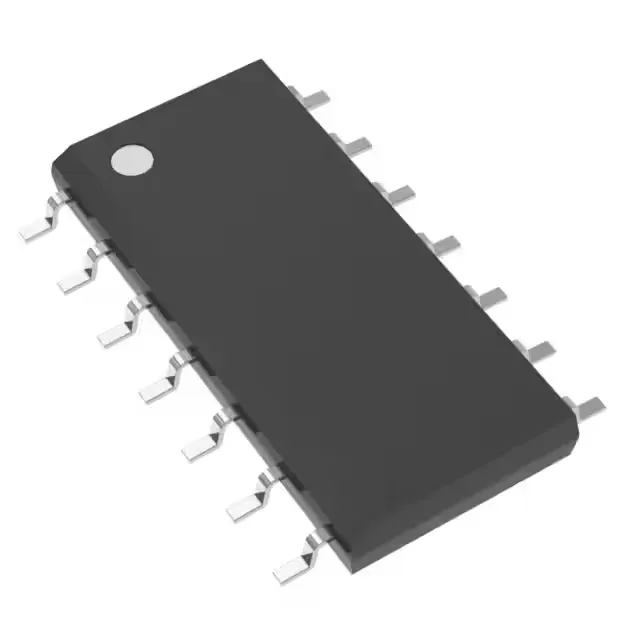
Quad op-amp, 1.2 MHz GBW — the general-purpose workhorse
Supply span runs from 3 V to 30 V, so it works off a single 5 V logic rail, a 12 V industrial bus, or dual ±15 V supplies without a separate regulator. Total quiescent current for all four amplifiers is 1.4 mA — roughly 350 µA per channel — which keeps the thermal rise low in the SOIC package.
At unity gain, the 0.5 V/µs slew rate supports a full 20 Vpp output swing up to about 8 kHz before slew-induced distortion sets in. For smaller swings the frequency ceiling scales proportionally. If your application needs to reproduce a 10 kHz square wave cleanly at 10 Vpp, this part will round the edges — look at a faster op-amp family instead. Input offset voltage is 2 mV typical, input bias current 15 nA. Those numbers are fine for DC-coupled signals from a few millivolts up; for microvolt-level precision or high-source-impedance transducers, a precision op-amp with lower Vos and Ib would be a better fit.
Active lifecycle — no end-of-life surprise
The base product number is LM324, one of the most widely second-sourced quad op-amp families in the industry. The 'A' suffix indicates tighter offset voltage limits than the original LM324. If your assembly line prefers Cut Tape, that option is also listed.