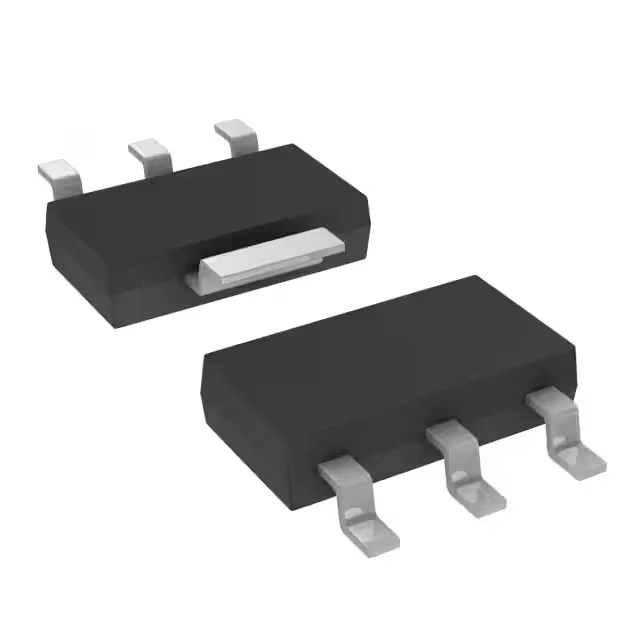
LM317MDCYR

Texas Instruments

Texas Instruments LM317MDCYR, adjustable positive voltage regulator, 500 mA output, 40 V input max, 1.25 V to 37 V output, PSRR 80 dB ~ 65 dB at 120 Hz, SOT-223-4, -40°C to 125°C.

Texas Instruments LM317MDCYR
Download datasheet (PDF)
[IN STOCK] In Stock: 2,339 pcs
$0.85/ pc

Volume pricing

Buy Now

MOQ 1 · Tape & Reel (TR); Cut Tape (CT) · RoHS · EIA-481 · DAP/DDP · T/T

Technical specifications

LM317MDCYR specifications
Parameter / AttributeSpecification / Value
Output typeAdjustable
MountingSurface Mount
Voltage - input40V
Voltage - output37V
Voltage - output (Min (Fixed))1.25V
Output current500mA
Current - quiescent10 mA
Operating temperature-40°C~125°C(TJ)
PSRR80dB ~ 65dB (120Hz)
PackageTape & Reel (TR); Cut Tape (CT)
CaseTO-261-4, TO-261AA
Protection featuresOver Current, Over Temperature, Short Circuit
Number of regulators1
Output configurationPositive
100% Footprint Match · Solder-Ready (No PCB Redesign Needed)

Need Stock or a Drop-in Second-Source for LM317MDCYR?

Package: TO-220 / SOT-223 / TO-92 / DPAK · Pin-compatible replacements with immediate Shenzhen spot stock

Footprint Match 99%
Supply Chain & Allocation Reality:

The LM317 has been the default adjustable linear regulator since the 1970s and remains in continuous production across TI, ST, onsemi and a long clone list. The confusion is all in the suffix: LM317, LM317T, LM317L and LM317M are the same regulator design at different packages and current limits, and the modern surface-mount sockets are usually filled by SOT-223 clones such as the AMS317. Where a rail needs more than the 1.5A a TO-220 LM317 can pass, the family ladder (LM350 at 3A, LM338 at 5A) is the correct answer - with a lower output-voltage ceiling as the trade.

Verified Pin-Compatible Replacements (4 verified alternatives)

LM317T STMicroelectronics / TI / onsemi TO-220
100% Drop-in (Zero Code Change)
Availability & Target Pricing:

The Full-Current Package, Named

Shenzhen Spot Stock (24-48h Dispatch)

Electrical & Core Specs:

The TO-220 member of the family: 1.5A output at the full 1.2V to 37V adjustment range, reference 1.25V, adjustment pin current about 50uA.

Input up to 40V class (see the vendor datasheet for the exact maximum differential); output 1.25V to 37V set by the two-resistor divider.

Compatibility & Drop-In Notes: Electrically identical to any other LM317 suffix; the T suffix simply names the TO-220 body that the original 1.5A headline rating refers to.
Package & Solder Footprint: TO-220, standard pin order ADJ / OUT / IN (confirm orientation from the front view; the pin row is not symmetric).
Shenzhen Warehouse Stock & MOQ: Deep multi-fab stock; the part every bench expects.
LM317L TI / onsemi TO-92
Functional Equivalent
Availability & Target Pricing:

Small Current, Small Body

Shenzhen Spot Stock (24-48h Dispatch)

Electrical & Core Specs:

The 100mA member: same 1.25V reference and adjustment behavior, but rated at a tenth of the TO-220 current.

Same 1.25V to 37V output range; input differential and dissipation limited by the tiny TO-92 body.

Compatibility & Drop-In Notes: Any direct swap between suffixes must respect the current rating: fitting an L part where a T failed thermally repeats the failure in miniature.
Package & Solder Footprint: TO-92 lead order differs from the TO-220 row - read the datasheet drawing rather than assuming.
Shenzhen Warehouse Stock & MOQ: Stocked as the repair-size part for instrument bias supplies.
AMS317 Advanced Monolithic Systems / multiple Chinese fabs SOT-223
Functional Equivalent
Availability & Target Pricing:

The SMD Socket Filler

Shenzhen Spot Stock (24-48h Dispatch)

Electrical & Core Specs:

The LM317-compatible adjustable regulator in SOT-223: same 1.25V reference and divider-based setting; current rating is package-limited (roughly 1A only with generous copper).

Same adjustment range; thermal behavior is the whole story - junction-to-ambient around 60 degC/W without a copper pour.

Compatibility & Drop-In Notes: Electrically a valid stand-in for small loads. Where the original was a TO-220 passing close to 1A continuously, the SOT-223 swap needs a thermal review, not a pin review - the footprint forces the conversation.
Package & Solder Footprint: SOT-223 with the tab as the output; the land pattern is the standard SOT-223 used across the clone family.
Shenzhen Warehouse Stock & MOQ: Massive Chinese-fab stock; the volume part of the adjustable-regulator market.
LM338 STMicroelectronics / TI TO-220 / TO-3
Functional Equivalent
Availability & Target Pricing:

The Current Ladder Top (5A)

Shenzhen Spot Stock (24-48h Dispatch)

Electrical & Core Specs:

The 5A member of the adjustable family: same adjustment topology, higher current die - and a lower output ceiling (around 32V rather than 37V).

Output to about 32V; input differential limits per the datasheet; LM350 (3A) sits between this and the LM317.

Compatibility & Drop-In Notes: Check the reduced maximum output voltage if the design ran an LM317 near 37V. Current capability is real only with the matching heatsink and input headroom.
Package & Solder Footprint: TO-220 pin order matches the LM317T row; TO-3 cans exist for the oldest fixtures.
Shenzhen Warehouse Stock & MOQ: Active production; stocked in the same drawer family as the LM317.
Buyer & Quality Checklist for Sourcing Alternatives
  • Decode the suffix before ordering: T = TO-220 (1.5A), L = TO-92 (100mA), M = mid-power TO-202 class (500mA), K = TO-3, D/S = DPAK/D2PAK, N or MP = SOT-223. Same regulator, different thermal envelopes.
  • The LM317 output cannot go below its 1.25V reference without a negative rail below ground - designs wanting a true 0V-output supply need a different regulator, not a different LM317.
  • SOT-223 clones (AMS317 and the Chinese fab family) are electrically compatible but package-limited: derate to roughly 1A and give the tab real copper or the part runs at its thermal wall.
  • For currents above 1.5A go up the ladder (LM350 3A, LM338 5A) and re-check the reduced maximum output voltage; two parallel LM317s are not a substitute.
  • The negative-rail complement for split supplies is the LM337, with mirrored pin order - never fit a positive part in the negative socket.
  • The adjustment-pin current is small but not zero (about 50uA): for precision outputs use the datasheet-recommended resistor network and keep the adjustment pin bypassed.
Frequently Asked Technical Questions

Q: What is the difference between LM317 and LM317T?

A: Package only: LM317T is the TO-220 body, which is the form the 1.5A rating refers to. Electrically the die family is identical across suffixes - the differences to watch are current rating and thermal resistance of each package.

Q: Can an AMS317 (SOT-223) replace a TO-220 LM317?

A: Electrically yes, thermally not blindly: the SOT-223 part is package-limited to roughly 1A with good copper and far less without it. On loads that heated the TO-220, the SOT-223 swap needs a dissipation review first.

Q: How do I get more than 1.5A from an LM317 circuit?

A: Step up the family: LM350 for 3A, LM338 for 5A (both with a slightly lower output ceiling), each with the heatsinking the current demands. Paralleling LM317s does not work because the parts do not share current.

Technical details

40 V input ceiling sets the supply headroom

Its 40 V maximum input and 500 mA output cover the common ground for powering analog rails, sensor supplies, and low-power logic from unregulated or semi-regulated DC buses. Output adjusts from 1.25 V up to 37 V with two external resistors — the classic LM317 topology. Single regulator, positive output configuration.

Ripple rejection at line frequency

PSRR is specified at 80 dB to 65 dB at 120 Hz. That 65 dB floor is the design-in number for a 60 Hz full-wave rectified supply — it tells you how much 120 Hz ripple bleeds through to the output. For a clean 5 V analog rail, that is still about 1.8 mV ripple from a 1 Vpp input ripple, which is acceptable for most 12-bit ADC references but marginal for a 16-bit precision chain.

SOT-223-4 — rework and thermal reality

The SOT-223-4 package (TO-261-4 equivalent) is surface-mount with a large centre tab. The tab is the thermal path and the output pin — it needs a solid copper pour and vias to the ground plane to keep junction temperature under 125°C at 500 mA with a moderate input-output differential.

Protection features and quiescent current

Built-in over-current, over-temperature, and short-circuit protection. Quiescent current is 10 mA typical — not a low-Iq part, so not for battery-powered always-on rails, but fine for line-powered industrial and automotive circuits.

LM317MDCYR
[ALLOC] verified
Quote