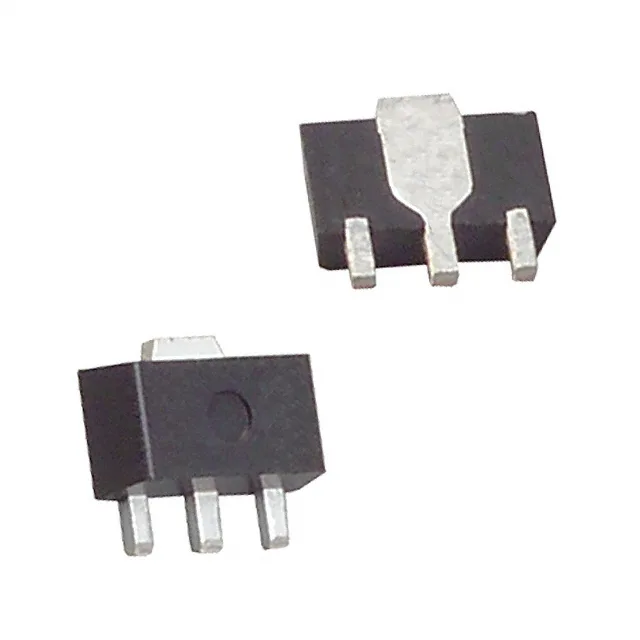
100 mA adjustable LDO — the classic three-terminal regulator in SOT-89-3
The LM317LCPK is a three-terminal adjustable positive LDO from the LM317 family, delivering 100 mA continuous output current in a surface-mount SOT-89-3 package. Output voltage is adjustable from 1.2 V up to 32 V using an external resistor divider, with a 38 V maximum input rating.
PSRR and protection — what the 80 dB at 120 Hz means on the bench
PSRR is specified at 80 dB typical at 120 Hz, rolling off to 65 dB at the same frequency — this is the ripple rejection a 100 Hz or 120 Hz full-wave rectified input sees. For a linear post-regulator cleaning up a bulk rail, that 80 dB knocks a 1 Vpp ripple down to 100 µVpp at the output. Above a few kHz the rejection drops faster than a modern LDO, so this part is best suited as a clean analog rail fed from a filtered DC bus rather than a switching converter output. Built-in protection covers over-current, over-temperature, and short-circuit events — the regulator folds back current during a fault and recovers when the junction temperature drops. No external clamp diode is needed for the output capacitor discharge during a short to ground.
SOT-89-3 footprint and thermal reality
The SOT-89-3 package has a large collector tab on the back side that serves as the thermal pad — it is internally connected to the output pin. On a standard 2-layer board with 1 oz copper, the tab should be soldered to a copper pour area of at least 300 mm² to keep the junction below 125 °C at full 100 mA load with a 38 V input-output differential. Without that copper area, the 0.5 W dissipation (100 mA × 5 V dropout) will push the junction above the 125 °C absolute maximum in still air. The 2.5 mA quiescent current is drawn from the input regardless of load — at light loads this dominates the efficiency, so for always-on battery applications a lower-Iq LDO like the TPS706 series is a better fit. For line-powered analog rails where the 2.5 mA is negligible, the LM317's simplicity and wide input range are the trade-off.