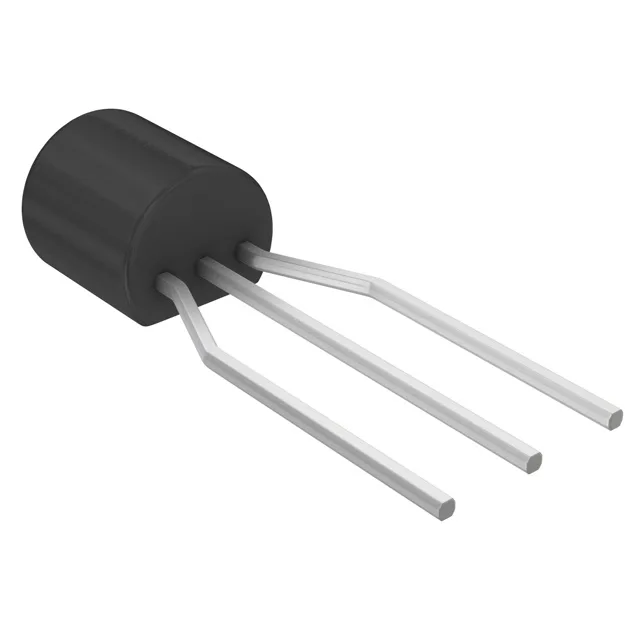
The Texas Instruments LM317LCLPRE3 is a positive adjustable linear voltage regulator delivering up to 100 mA output current. It is part of the LM317 family, a three-terminal design that sets the output voltage with two external resistors. The output adjusts from 1.2 V up to 32 V, with a maximum input of 38 V. Built-in protection includes over-current, over-temperature, and short-circuit limits.
PSRR at line frequency — what 80 dB to 65 dB means for your rail
The PSRR is specified as 80 dB to 65 dB at 120 Hz. This is the rejection of full-wave-rectified ripple from a 60 Hz mains supply. At 80 dB, a 1 V peak-to-peak ripple on the input is attenuated to about 100 µV on the output. The roll-off to 65 dB at the same frequency means the rejection degrades as the load or input conditions shift, but still holds roughly 65 dB of attenuation. For a 5 V rail feeding an analog front end, that keeps line-frequency hum below the microvolt level — sufficient for most 12-bit ADC references. If the load draws close to the 100 mA maximum, expect the rejection to sit nearer the 65 dB end of the range.
Package and mounting — through-hole TO-92-3
The LM317LCLPRE3 comes in a TO-92-3 through-hole package with formed leads (TO-226AA variant). The three leads are input, output, and adjust — standard for the LM317 topology. The through-hole format suits prototyping, low-volume builds, and boards where reflow is not an option. The formed-lead variant is intended for direct PCB insertion or socket mounting. Thermal dissipation is limited by the TO-92 body; at 100 mA output with a moderate input-to-output differential, the junction temperature stays within the 125°C maximum, but a heatsink is not practical on this package — keep the differential low if running near the current limit.
The ROHS3 compliance is current. For BOM planning, the LM317LCLPRE3 is a standard catalog item available through independent distribution.