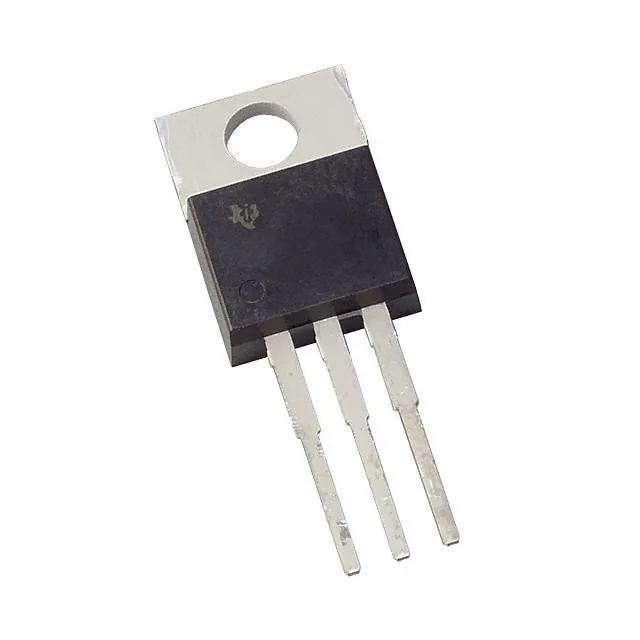
Adjustable regulator for the 1.5A rail
The Texas Instruments LM317KCSE3 is the through-hole TO-220-3 variant of the classic adjustable positive voltage regulator. It delivers up to 1.5A output current with an output adjustable from 1.25V up to 37V, fed from an input rail rated to 40V max.
At 1.5A continuous output, this regulator covers medium-current loads: analog front-end supplies, fan drivers, relay coils, or post-switcher clean rails. Built-in over-current, over-temperature, and short-circuit protection means you can skip external foldback or crowbar circuits for basic fault handling, though a reverse-bias diode across the output is still good practice if the load can back-drive the regulator.
PSRR at 120 Hz — line-frequency ripple rejection
Ripple rejection runs 80 dB to 65 dB at 120 Hz, which is the standard rectified-mains frequency. That 80 dB floor at lighter loads means the output sees only microvolts of ripple from a poorly filtered bulk cap — relevant if you are feeding a sensitive analog chain (op-amp rails, ADC reference, audio preamp). At higher loads the rejection drops to 65 dB, still adequate for most mixed-signal boards. If you need better rejection above a few kHz, plan for a post-filter LC stage.
Package and mounting — TO-220-3 through-hole
The tab is electrically connected to the output pin, so an insulating pad and washer are needed if you mount it to a grounded chassis. Through-hole mounting suits point-of-load regulation on boards where wave solder is the primary assembly process, or where the thermal mass of the tab needs a bolt-down heat sink rather than PCB copper.
That covers commercial and most industrial environments — office equipment, appliance control boards, industrial sensor interfaces, power supplies for test gear — but not automotive under-hood or outdoor telecom cabinets where -40°C cold starts are required. If the bill of materials needs a -40°C low end, you would step to the LM317M or an automotive-grade variant.
No last-time-buy risk, no PCN for imminent EOL. The classic LM317 footprint means second-source options exist across multiple vendors, though the KCSE3 suffix is a specific TI orderable.