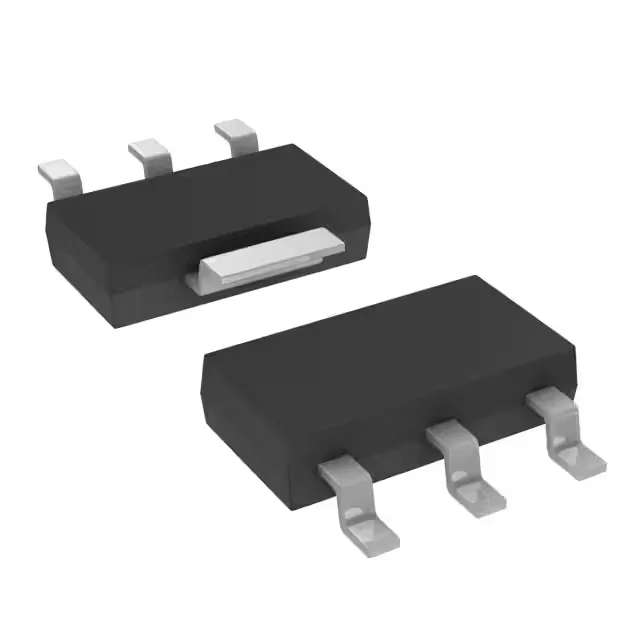
1.5 A adjustable regulator in SOT-223 — thermal budget is the real limit
The LM317DCYR is Texas Instruments' surface-mount variant of the classic LM317 adjustable positive voltage regulator, delivering up to 1.5 A output current in a SOT-223-4 package. The SOT-223-4 footprint (TO-261AA) is the key difference from the through-hole LM317T in TO-220. The surface-mount case has higher junction-to-ambient thermal resistance, so the 1.5 A rating is achievable only with adequate copper area on the PCB and airflow — at elevated ambient temperatures the output current must be derated. For a 24 V to 5 V conversion at 1 A, the power dissipation is roughly 19 W; the SOT-223 package cannot sustain that without a heatsink or forced air, so plan the thermal path early.
PSRR at 120 Hz — ripple rejection for analog rails
The LM317DCYR provides 64 dB of ripple rejection at 120 Hz, dropping to 57 dB as the output current increases. This is the line-frequency (full-wave rectified) rejection that matters when the regulator is cleaning up a bulk capacitor's ripple before feeding an analog load — op-amp supplies, ADC reference buffers, or audio preamp rails. The 57 dB floor means about 0.14% of the input ripple couples through; if the input has 1 Vpp of 120 Hz ripple, the output sees roughly 1.4 mVpp. For a 5 V rail feeding a 16-bit ADC with a 5 V reference, that ripple is about 0.5 LSB at the converter input — acceptable for many designs, but a lower-noise post-filter may be needed for precision chains.
Protection and quiescent current — built-in ruggedness
The LM317DCYR integrates overcurrent, overtemperature, and short-circuit protection, so no external crowbar or foldback circuit is needed. The quiescent current is 10 mA typical, which is the current the regulator consumes to bias its internal reference and error amplifier — this flows to ground regardless of load and must be included in the total supply budget. In a battery-powered system drawing 50 mA from the output, the 10 mA Iq represents a 20% overhead; for line-powered designs it is negligible.
No official successor or replacement part has been issued.