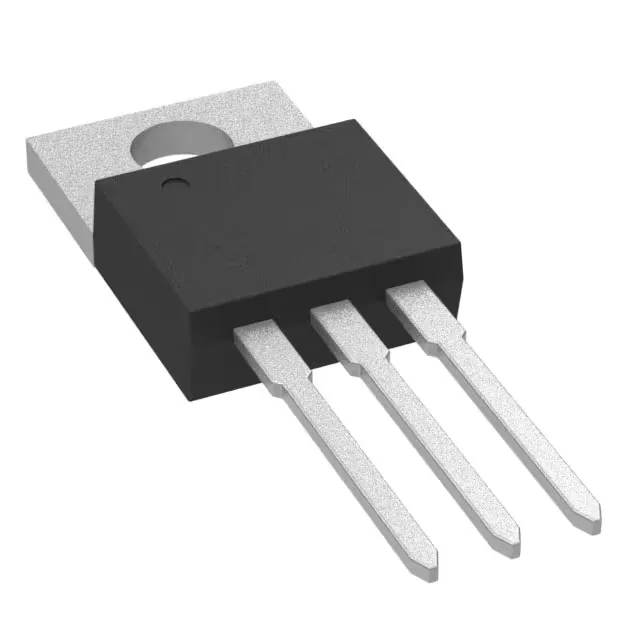
Adjustable linear regulator in a TO-220 — what the ratings mean
The Texas Instruments LM317AT/NOPB is a three-terminal adjustable positive voltage regulator delivering up to 1.5 A output current from a 40 V maximum input rail, with an adjustable output range from 1.25 V to 37 V set by two external resistors. It comes in a standard TO-220-3 through-hole package with integral tab for heatsinking — the same footprint used across the LM317 family for decades.
PSRR at 120 Hz — ripple rejection where it matters
PSRR is listed at 80 dB typical, dropping to 65 dB at 120 Hz. That 120 Hz point is the fundamental ripple frequency from a full-wave bridge rectifier — so in a linear post-regulator stage, this part knocks down the bulk-capacitor ripple by a factor of roughly 1800 at 80 dB, still over 1700 at 65 dB. For a 5 V rail with 100 mVpp input ripple, the output sees under 60 µVpp — clean enough for most analog front-end supplies.
Protection built in — no external watchdog needed
Over-current, over-temperature, and short-circuit protection are integrated on-chip. The current-limit and thermal-shutdown circuits are active across the full temperature range, so a sustained output short or a heatsink that's undersized for the dissipation won't cascade into a board-level failure. That makes it a common choice for unregulated DC-input rails where the upstream supply can surge or drop out.
The TO-220 package and the LM317 core topology have been in continuous production across multiple suppliers for decades — the supply base is broad and the tooling is mature.