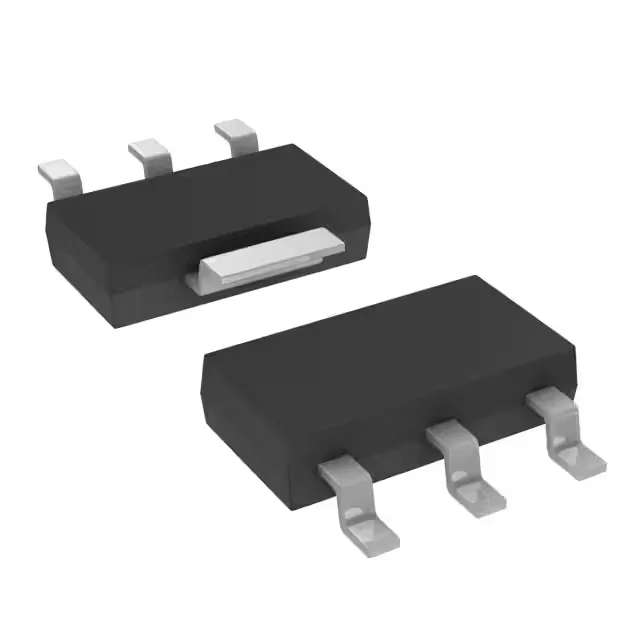
Fixed 10 V output — no adjustment, no divider
The LM2937IMPX-10/NOPB is a fixed 10 V positive linear regulator. There are no adjust pins, no external resistor divider — the output voltage is set internally to 10 V, ±2 % typical. If your BOM calls for a 10 V rail to power an analog front-end, a sensor bias, or a relay coil supply, this is the regulator; if you need 3.3 V or 5 V, look elsewhere in the LM2937 family. Output current is rated at 400 mA. That is enough for a handful of op-amps, a small relay bank, or a 10 V reference pre-regulator, but not enough for a microcontroller core or a multi-amp load. Plan your load budget to stay below 400 mA continuous, and derate for ambient temperature above 25 °C — the SOT-223-4 package has a thermal resistance around 60 °C/W junction-to-ambient on a standard two-layer board.
Dropout and input headroom — 1 V at 50 mA, not at 400 mA
The datasheet lists maximum dropout as 1 V at 50 mA. For a 10 V output, plan for an input voltage of at least 11.5 V to 12 V to stay in regulation across temperature and load. The absolute maximum input is 26 V, so a 12 V rail or a 15 V unregulated supply is safe. Compared to a low-dropout regulator like the LP5907UVX-3.3/NOPB (which has a dropout of 120 mV at 250 mA), the LM2937 is not a true LDO. It is a standard NPN-pass regulator with a Darlington output stage — the dropout voltage is the Vce(sat) of the pass transistor plus the base-drive overhead. That means the input rail must be at least 1 V above the output at light load, and more at full load.
Protection features — over-temp, reverse polarity, short circuit
The LM2937 includes over-temperature shutdown, reverse-polarity protection, and output short-circuit current limiting. The reverse-polarity block is notable: if the input voltage is accidentally reversed, the regulator limits reverse current to a few milliamps instead of letting the pass transistor conduct heavily. That saves an external series diode on the input, which would otherwise add a 0.6 V drop and waste power. That is not a micropower regulator — for battery-operated designs drawing microamps, look at the LP5907 family. But for a 10 V rail fed from a 12 V bus, 2 mA Iq is negligible.
The centre tab is the output pin and also the main thermal path — solder it to a copper pour on the PCB to improve heat dissipation. The LM2937IMPX-10/NOPB is the tape-and-reel variant; the cut-tape version is also available. The base product number is LM2937, so the same die is used across the LM2937 family — only the output voltage and package change.
That means the BOM line is safe for new designs and production runs — no last-time-buy scramble, no successor search.