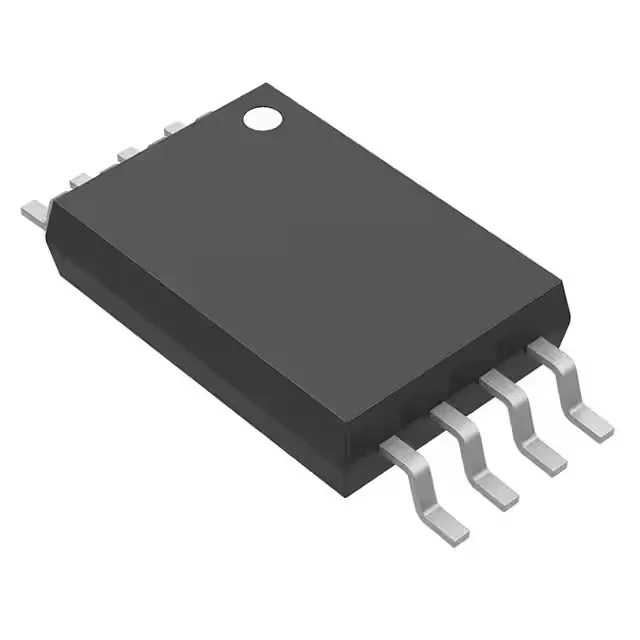
AEC-Q100 qualified dual op-amp for automotive and industrial signal chains
The Texas Instruments LM2904VQPWRQ1 is a dual-channel, general-purpose operational amplifier from the automotive-grade LM2904V family, qualified to AEC-Q100 for deployment in automotive electronics. Each of the two amplifiers draws 500 µA supply current, a balance of quiescent economy and bandwidth that suits always-powered automotive modules such as transmission controllers, brake-system interface boards, and battery-monitoring front-ends. The gain-bandwidth product of 700 kHz and slew rate of 0.3 V/µs cover the frequency range needed for filtering, level-shifting, and buffering of slow-to-moderate-speed sensor signals — thermocouple, RTD, pressure transducer, and hall-effect outputs — without the excess loop gain that can cause stability issues in noisy automotive environments.
The supply span from 3 V minimum to 26 V maximum covers the common automotive battery rails: 5 V regulated, 12 V nominal, and 24 V truck/industrial buses. Each output channel can source or sink 30 mA, enough to drive the analog input of a typical automotive ADC, bias a transistor stage, or switch a small LED indicator. For loads beyond 30 mA per channel, an external buffer stage is needed. For sub-millivolt accuracy applications, a zero-drift or precision amplifier family would be the correct tier.
Package and mounting — 8-TSSOP footprint details
Housed in an 8-TSSOP package with 0.173" body width (4.40 mm), surface-mount only. This is a standard fine-pitch SOIC alternative, compatible with automated pick-and-place and reflow assembly common in automotive ECU production. The TR variant is the usual ordering code for volume production; CT suits prototyping and low-volume builds.
ROHS3 compliant.