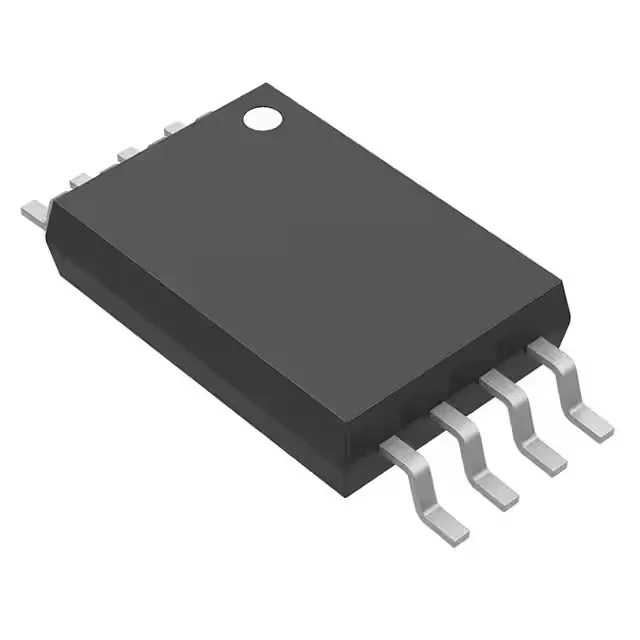
The LM2904PWR: The part remains ROHS3 compliant per TI's last production run, so it still passes modern assembly restrictions without a waiver.
700 kHz GBW, 0.3 V/µs slew — signal conditioning fit
Slew rate of 0.3 V/µs limits large-signal response: a 5 V peak-to-peak output step slews in about 17 µs, which caps the full-power bandwidth near 9 kHz. This matters if the output must track fast transients from a DAC or a comparator front-end. Supply span from 3 V to 26 V covers single-supply 5 V and 12 V rails as well as split supplies down to ±1.5 V — the wide compliance makes it a drop-in for existing 5 V or 24 V industrial designs without re-spinning the power rail.
Dual-channel, 500 µA per amplifier — board-level integration
Quiescent current of 500 µA per channel (1 mA total for both amplifiers) keeps the thermal contribution low — in a still-air environment the junction rise above ambient stays under 10°C even at 26 V supply, so no special copper pour or airflow is needed. Input bias current of 20 nA and input offset voltage of 3 mV are typical for a general-purpose bipolar stage — adequate for signals above a few millivolts with source impedances under 50 kΩ. For precision DC-coupled circuits below 1 mV the offset may need trimming or a chopper-stabilized alternative.
It suits outdoor telecom cabinets, engine-bay sensor interfaces, and factory-floor PLC analog input stages. Output current capability of 40 mA per channel lets each amplifier drive a 2 kΩ load to within 1.5 V of the rails — enough to feed a downstream ADC input or a small relay coil through a series resistor.