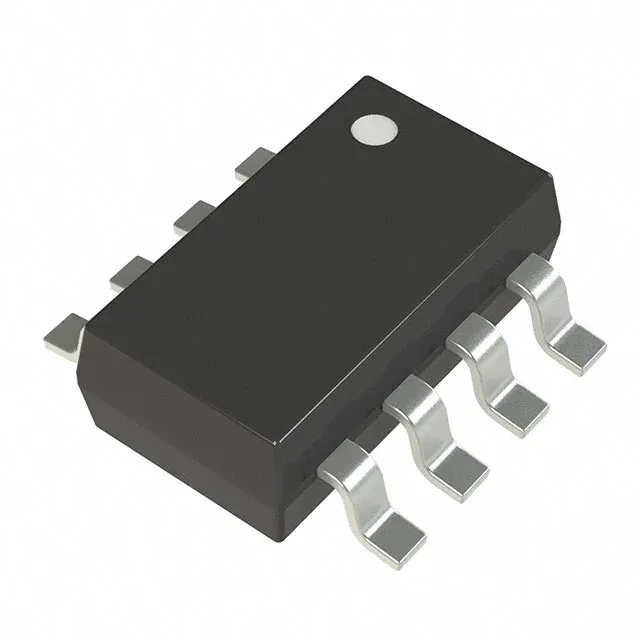
Dual op-amp for low-voltage, space-constrained boards
Each of the two channels draws 90 µA of supply current, which keeps the total quiescent draw under 200 µA — a meaningful advantage in battery-powered or always-on sensor interfaces where every microamp counts.
Parametric envelope: speed, precision, drive
The 1 MHz gain-bandwidth product and 1.5 V/µs slew rate define the usable signal bandwidth: expect clean amplification up to roughly 100 kHz for small signals, with the slew rate limiting large-swing outputs above about 240 kHz. This is not a high-speed video or RF amplifier — it is sized for sensor conditioning, filter stages, and low-frequency control loops. The 15 pA bias current is low enough that high-impedance sources (10 kΩ or higher) do not introduce significant offset error, simplifying front-end design for photodiode or thermocouple amplifiers.
Package and footprint: SOT-23-8 vs TSOT-23-8
These two designations refer to the same 8-pin footprint — the body dimensions and pad layout are interchangeable for board layout purposes. The package is surface-mount only, so a reflow profile compatible with lead-free solder is required. This temperature grade is a key differentiator from commercial-grade op-amps that top out at 70°C.
For BOM planning, the base product number LM2904 spans multiple variants with different temperature grades and packages. The LVIDDFR suffix specifically identifies the low-voltage, industrial-temperature, SOT-23-8 variant.