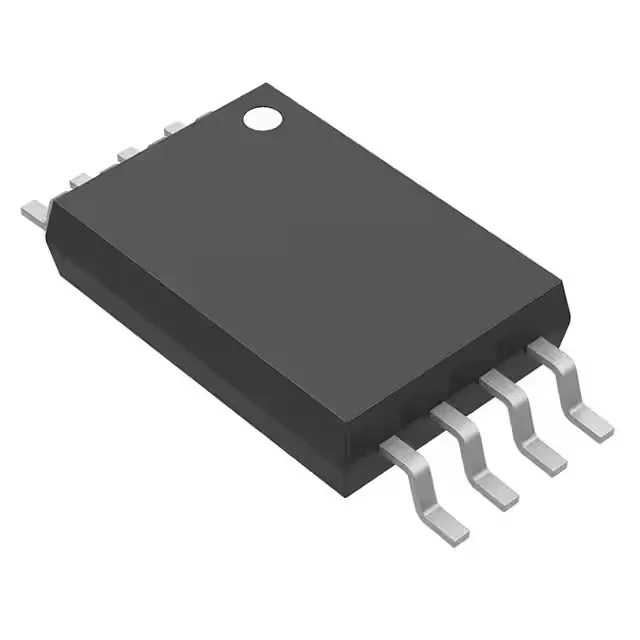
AEC-Q100 dual comparator for 12V/24V automotive and industrial rails
The 8-TSSOP package (0.65 mm pitch) matches the industry-standard comparator footprint used across the LM2903 family, so a layout designed for an LM2903 in an SOIC-8 or MSOP-8 can often accommodate this part with a minor land-pattern adjustment.
Parametric limits that set the threshold accuracy
Maximum input offset voltage is 7 mV at 5V supply, and maximum input bias current is 0.25 µA at 5V. These define the comparator's switching-point uncertainty in window detectors, zero-crossing circuits, and over-voltage/under-voltage monitors. For a 12V rail monitored with a resistor divider, the 7 mV offset translates to roughly 0.06% of the divider output — negligible for most protection thresholds, but worth verifying if the trip point must hold within 1% without trimming. Output current is rated 20 mA typical, sufficient to drive a logic input, an LED indicator, or a small relay coil through an open-collector pull-up. The output stage supports CMOS, MOS, open-collector, and TTL logic families, so it interfaces directly with 3.3V or 5V microcontroller GPIO without a level shifter. Quiescent current is 2.5 mA max per device — the dual comparator draws up to 5 mA total from the supply rail. In a battery-backed ECU or sensor module that sleeps between measurement cycles, this quiescent draw may need a load switch to disconnect the comparator during standby.
The AEC-Q100 qualification includes the full Grade 1 temperature range and the associated reliability stress tests (HTOL, TC, HAST) that commercial-grade comparators do not carry.