Each of the four channels draws 90 µA typical supply current, making this a strong candidate for multi-channel sensor conditioning, battery-monitoring front-ends, and industrial control loops where per-channel power budget is tight.
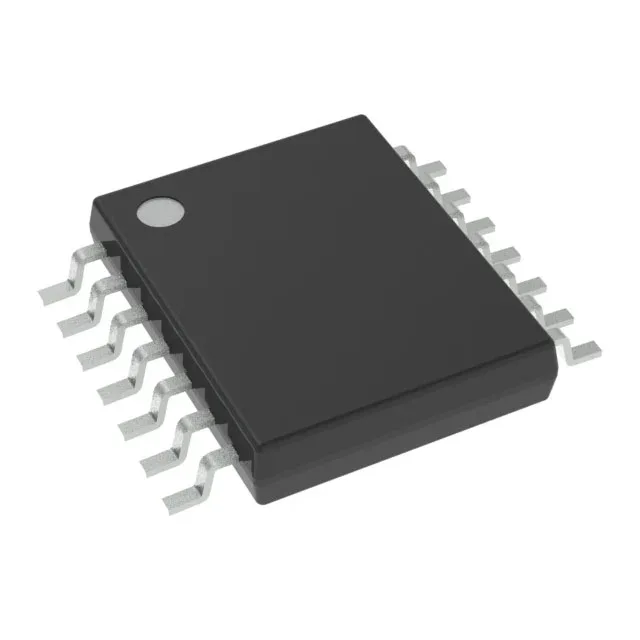
14-TSSOP: footprint and rework notes
The 14-TSSOP package (0.173-inch body width, 4.40 mm) is a fine-pitch surface-mount part. The 0.65 mm lead pitch is hand-solderable with a fine tip, but rework under hot air needs a profile that keeps the body below 260 °C peak — the thin TSSOP body can delaminate if the ramp rate exceeds 3 °C/s above 150 °C. The 14-TSSOP footprint is shared with many logic and interface parts, so a common land pattern on the board eases alternate sourcing.
Input bias and offset — what they mean for precision loops
Input bias current is 15 pA typical — a CMOS-input-level figure that lets the designer use high-value feedback resistors (100 kΩ to 1 MΩ) without introducing significant voltage error. This matters for transimpedance amplifiers and precision integrators where bias current times feedback resistance would otherwise dominate the output offset. Input offset voltage is 1 mV typical. In a unity-gain buffer, that is a 1 mV DC error at the output — acceptable for 8-bit or 10-bit signal chains but worth budgeting in a 12-bit system where 1 mV may represent several LSBs at a 3.3 V reference.