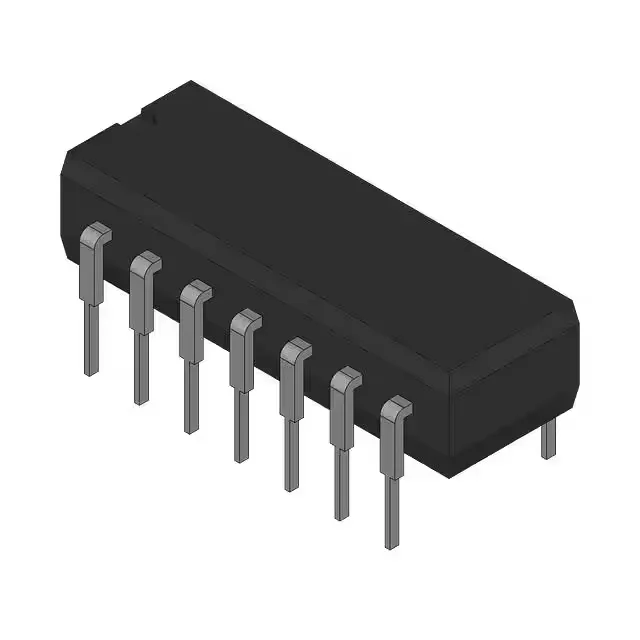
Quad op-amp with 20 V/µs slew rate in a through-hole DIP
The LM2900NE4: It delivers a 20 V/µs slew rate and 2.5 MHz gain-bandwidth product across a supply span from 4.4 V to 32 V. The four amplifiers share a total supply current of 6.2 mA, each capable of sourcing or sinking 18 mA output current. Input bias current is 30 nA.
The 20 V/µs slew rate is the standout parametric here. A standard LM324 family op-amp slews at about 0.5 V/µs. At 20 V/µs the LM2900NE4 can track a 10 V peak-to-peak sine wave up to roughly 318 kHz before the output starts distorting from slew limiting — versus about 8 kHz for an LM324. That matters for faster sensor signal conditioning, waveform generation, or active filter stages where the LM324 runs out of steam. The trade-off: the LM2900NE4 draws 6.2 mA total supply current versus roughly 1.5 mA for an LM324 — budget the extra 4.7 mA against the performance gain.
Active lifecycle and supply-span flexibility
The 4.4 V minimum supply lets it run from a single 5 V rail with margin; the 32 V maximum covers 24 V industrial rails and ±15 V split supplies. The through-hole 14-DIP footprint is the same as the LM324, LM348, and similar quad DIP-14 op-amps, so it drops into existing board layouts without a PCB change. If you are dual-sourcing a through-hole quad op-amp, this is a current-production option — no need to redesign for a surface-mount part.