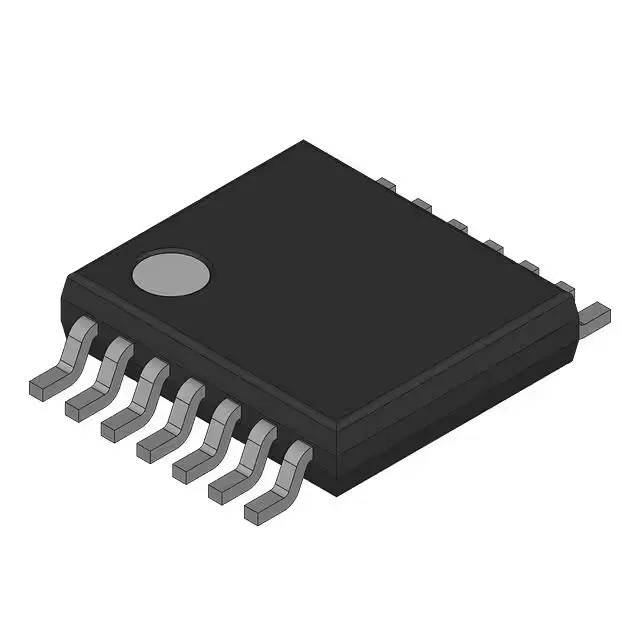
The Texas Instruments LM2737MTC is a voltage-mode buck (step-down) switching controller designed for single-output, positive-polarity supplies. It drives an external transistor pair and integrates synchronous rectification for higher efficiency in low-voltage rails. The controller operates from a 4.5 V to 5.5 V supply and switches between 50 kHz and 2 MHz, letting the designer tune inductor size against switching losses. Control features include current limit, enable, frequency control, a power-good flag, and soft-start — enough for sequenced power-up and fault handling in a compact 14-TSSOP footprint.
The LM2737MTC covers 50 kHz to 2 MHz. At the low end you use a larger inductor but get lower core losses and less EMI headache; at 2 MHz the inductor shrinks and the ripple frequency moves above the AM band, but gate-drive losses and magnetic-core losses climb. The part does not synchronise to an external clock (no clock sync), so the frequency is set by an external resistor — make sure your layout keeps the timing node clean.
The 90% maximum duty cycle gives headroom for low-dropout operation when the input sags close to the output target.
Housed in a 14-lead TSSOP (4.40 mm width), the part is surface-mount only. The supplier device package is 14-TSSOP; the shipping form is Bulk (tube or tray). No special thermal pad — the junction-to-ambient path relies on the board copper.