Dual synchronous buck for multi-rail POL designs
The Texas Instruments LM2647LQ/NOPB is a dual synchronous buck regulator controller that drives two independent step-down outputs from a single 5.5V to 28V input rail. Each output uses an external transistor driver, so the power-stage FETs are sized to the load current rather than baked into the controller — useful when one rail pulls 3 A and the other 15 A. The dual-phase architecture with synchronous rectification keeps the output ripple low and the efficiency curve flat across a wide load range, which matters when the downstream loads are sensitive to supply noise or when the board runs hot and every percentage point of efficiency saves a fan.
Switching frequency and control flexibility
The switching frequency is programmable from 200 kHz to 500 kHz via an external resistor on the Frequency Control pin. A 200 kHz setting minimises switching losses in the FETs and is a good fit for higher-voltage inputs where the duty cycle is narrow; 500 kHz shrinks the output inductor and capacitor, saving board area at the cost of slightly higher gate-drive loss. The maximum duty cycle is 75%, which means the controller cannot run at 100% dropout — the input must stay at least 25% above the output voltage to maintain regulation. For a 3.3 V output, the minimum input is about 4.4 V, comfortably inside the 5.5 V lower end of the supply range. Control features include current limit, enable, soft start, and a Power Good flag. The soft-start pin sets the ramp time with an external capacitor, preventing inrush current from pulling the input rail down during startup on a heavily loaded output.
Package, temperature grade, and board integration
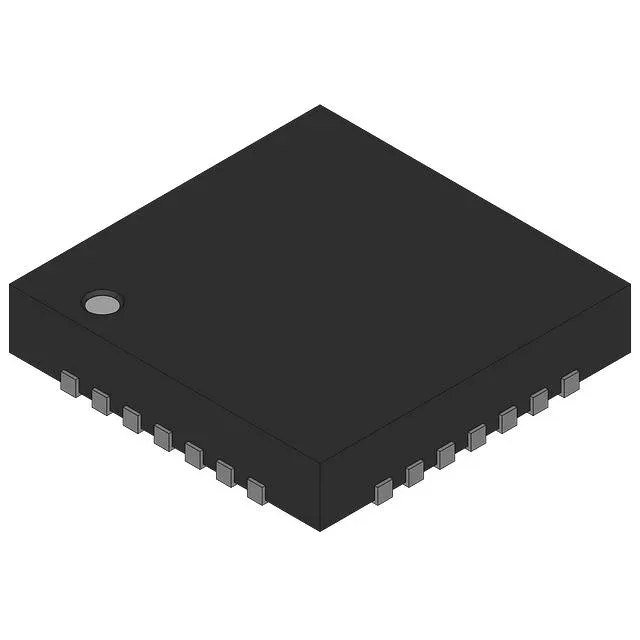
Housed in a 28-lead WQFN with exposed pad (5 mm × 5 mm), the LM2647LQ/NOPB requires a thermal land on the PCB to draw heat from the die into the board's copper plane. The junction temperature range is -5°C to 125°C, which covers industrial ambient conditions but not the full -40°C automotive band — if the board sees cold starts below -5°C, the controller may not start until the environment warms. The package is supplied in bulk (not tape-and-reel), so it is suited for prototype builds or low-volume production where the pick-and-place feeder setup for a reel is not justified. For higher volumes, confirm the packaging option with the supplier at RFQ time.
Because it is an active part, the supply channel is straightforward: we source it against an RFQ from TI's authorized network, with pricing and lead time confirmed at quote time. The BOM line is not at risk of a sudden EOL, but the dual-output synchronous buck controller space has several pin-compatible alternatives worth reviewing if single-source risk is a concern.