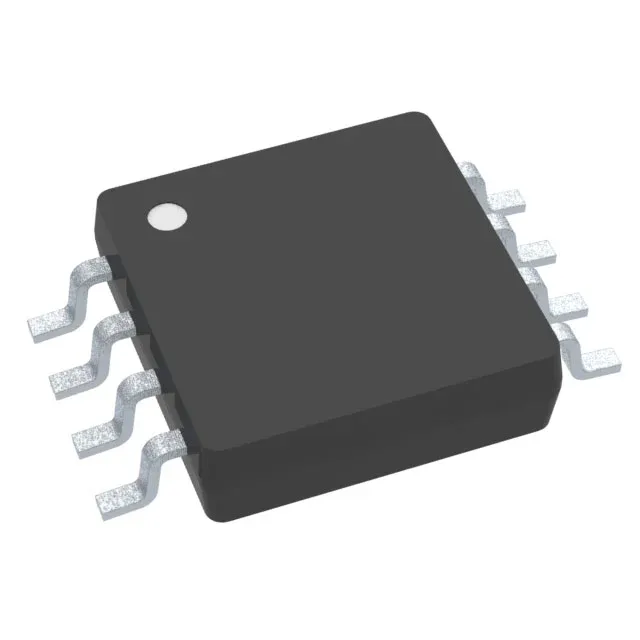
Board-fit and package detail for the layout engineer
The LM2623AMM/NOPB: Either way, the MSL (moisture sensitivity level) is not stated in this record, but for an MSOP-8 with an exposed pad, assume MSL-1 or MSL-2 unless the reel label says otherwise; bake only if the bag seal is broken and the humidity card reads above 30%.
What the key parametrics mean for your BOM
This is a step-up (boost) converter with a single 2.2 A internal switch — the 2.2 A is the peak current limit of the switch itself, not the continuous output current. At a 5 V output from a 3.3 V input, you'll get roughly 1.2 A continuous before the switch hits its cycle-by-cycle limit; derate further at higher output voltages because the duty cycle eats into the available switch on-time. The input range is 0.8 V minimum to 14 V maximum — it starts from a single alkaline cell (0.8 V is below the cutoff of a fresh NiMH) and runs all the way to a 12 V rail. The output is adjustable from a 1.24 V reference up to 14 V, set by an external resistor divider. No synchronous rectifier (external Schottky required), so the diode forward drop and switching losses eat into efficiency at higher switching frequencies. Switching frequency is programmable from 300 kHz to 2 MHz via an external resistor — pick 300 kHz for best efficiency (lower gate-drive losses) or 2 MHz to shrink the inductor and output capacitor at the cost of about 5-8% efficiency drop.
Lifecycle and compliance — what the record says
It's ROHS3 compliant, so it passes the latest EU RoHS exemption list (no lead, no halogens beyond trace limits). No REACH or UL certification is stated in this record, but TI typically provides a full material declaration on request. Because it's Active, you can source it through authorized distribution without a last-time-buy clock ticking.