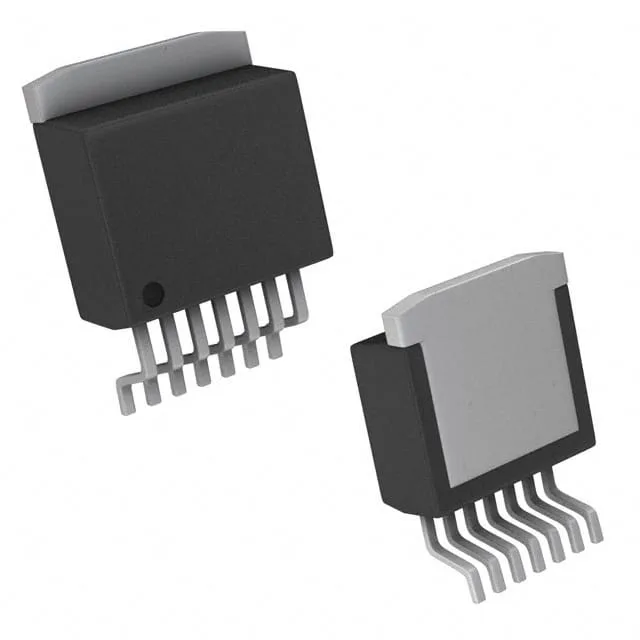
The LM2598SX-ADJ/NOPB is a 1 A continuous-output step-down (buck) regulator from the SIMPLE SWITCHER® family. The 150 kHz switching frequency is fixed — no external sync or frequency-adjust pin — which simplifies the layout but limits the inductor size reduction you get with a higher-frequency part. For a 1 A rail, the inductor at 150 kHz will be physically larger than what a 500 kHz or 1 MHz regulator would need. Input voltage range is 4.5 V to 40 V, and the adjustable output spans 1.2 V to 37 V. The 40 V input ceiling covers 24 V industrial rails with margin for transients, but a 48 V telecom bus is out of range. The 1.2 V minimum output means it can generate a 1.2 V core rail, but the 1 A limit constrains which core it can feed — a small MCU or FPGA auxiliary rail, not a high-current processor core. The part does not include a synchronous rectifier — the low-side freewheeling diode is external. This keeps the BOM cost down but pushes the rectifier loss outside the IC, so the diode's forward voltage and thermal rating become part of the efficiency calculation. At 1 A output, a Schottky diode with a Vf around 0.4 V dissipates roughly 0.4 W; the junction temperature of the diode must be derated against the ambient.
The LM2598SX-ADJ/NOPB comes in a TO-263-8 / D²Pak (7 leads plus tab) package, surface-mount. The supplier device package is DDPAK/TO-263-7. For 1 A continuous at high input-to-output differential, the tab should be soldered to a flooded copper plane on the top layer, with thermal vias to inner or bottom layers. The 125°C ceiling is the junction limit, not the ambient; the actual ambient capability depends on the power dissipation and the board's thermal design. At 1 A with a 12 V to 5 V conversion (7 V drop), the IC dissipates roughly 7 W — that requires substantial copper area or forced air to stay below 125°C junction.
Compliance documentation
Texas Instruments provides RoHS3 compliance for the LM2598SX-ADJ/NOPB.