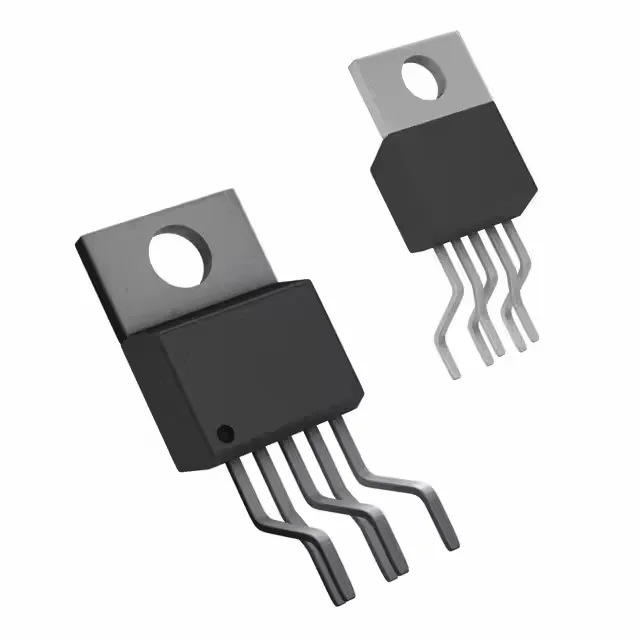
Through-hole buck regulator for industrial and automotive rails
The Texas Instruments LM2576T-ADJ/LF03 is a SIMPLE SWITCHER® step-down buck regulator delivering 3 A from a 4 V to 40 V input rail, with an adjustable output from 1.23 V up to 37 V. The 52 kHz switching frequency is low enough to keep layout and EMI manageable without a shielded inductor, though the inductor itself will be physically larger than what a 500 kHz part needs. The TO-220-5 through-hole package with formed leads suits point-of-load regulation on a heatsink-mounted board or a chassis-mount assembly where a TO-220 tab can be bolted to a metal panel for thermal relief.
Output current and thermal budget
At full load with a 40 V input and 5 V output, the power dissipation in the pass transistor will be around 10 W, requiring a heatsink with a thermal resistance below 10°C/W to keep the junction under 125°C in a 50°C ambient. The TO-220 tab is the primary heat path — a board-mount clip or a bolt-through heatsink is expected for sustained 3 A operation.
Switching frequency and component selection
The 52 kHz fixed switching frequency means the inductor value will be in the 100 µH to 330 µH range for most output voltages, and the output capacitor ripple current rating needs to handle the inductor ripple. The regulator does not use synchronous rectification — an external Schottky diode (rated for at least the input voltage and 3 A average current) is required between the switch node and ground. The diode's forward voltage and reverse recovery time directly affect efficiency, so a 40 V, 3 A Schottky with a Vf under 0.5 V at 3 A is the standard pairing.
For dual-sourcing, a cross-reference to a TO-220-5 adjustable buck from another vendor would require verifying the compensation pin and feedback divider network, as the internal compensation and reference voltage differ between manufacturers.