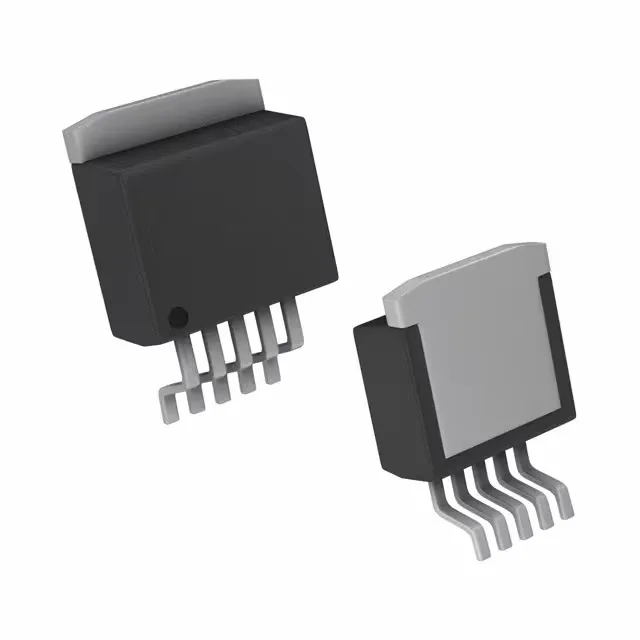
60 V input, 3 A output — why this regulator still gets specified
The LM2576HVS-ADJ is a SIMPLE SWITCHER® step-down (buck) regulator from Texas Instruments, delivering up to 3 A from an input range of 4 V to 60 V. The adjustable output version sets its voltage via two external resistors from a 1.23 V reference up to 57 V. This 60 V input ceiling covers 24 V industrial rails with margin for load-dump transients, 48 V telecom buses, and 12/24 V automotive systems — the 3 A output handles auxiliary rails, sensor supplies, and local point-of-load regulation.
52 kHz switching — the inductor size trade-off
The fixed 52 kHz switching frequency is low by current-generation standards. That means the external inductor and output capacitor will be physically larger than what a 200 kHz+ switcher would need — roughly 100 µH to 330 µH for typical 3 A designs. The trade-off is lower switching losses and simpler EMI management: the fundamental and its harmonics sit well below the AM broadcast band, and the layout is less sensitive to parasitic capacitance. For a board that already has space, the 52 kHz SIMPLE SWITCHER topology is forgiving and well-documented. The part does not use synchronous rectification — it relies on an external Schottky catch diode. At 3 A output, the diode forward drop dominates the thermal budget; a 3 A, 60 V Schottky in a D²Pak or similar is the standard companion. The 52 kHz rate keeps diode heating manageable, but the diode must be rated for the full 60 V input plus switching ringing margin.
NRND — still available, but plan the transition
No official last-time-buy date or successor part number is recorded on this listing. For existing BOM lines already qualified, the part remains a valid procurement choice while channel inventory lasts. For new designs, a more modern pin-compatible or functionally equivalent buck regulator should be evaluated before the layout is frozen.
Package and temperature grade — DDPAK for the power loop
The tab is the primary heat path: at 3 A output and a typical 12 V to 5 V conversion, the die dissipates roughly 2–3 W, demanding a 1 in² copper area on a 2 oz board to keep TJ below 125°C.