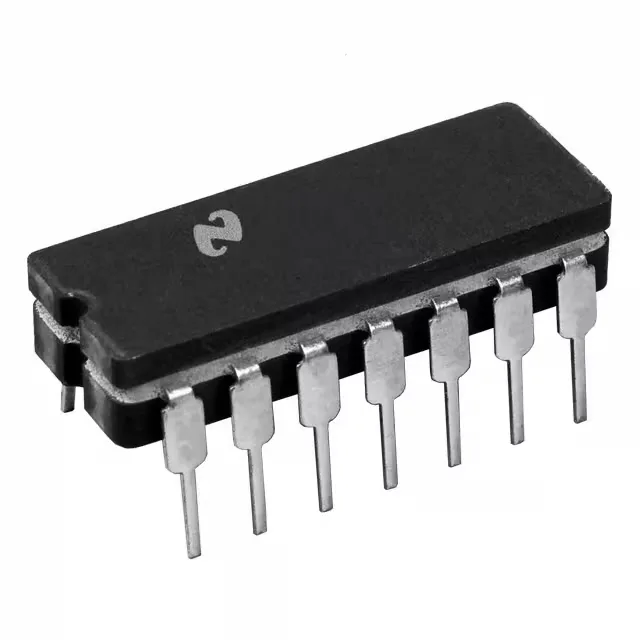
Quad comparator in a ceramic DIP — field-swappable and wide-supply
The LM239J: Four independent comparators in one ceramic DIP — useful where you need multiple threshold detections or window comparators on a single IC, and the ceramic body handles higher-temperature soldering and rework cycles better than plastic. The wide common-mode input range includes ground, so it can sense near-zero signals directly. Output stage is open-collector compatible with CMOS, DTL, ECL, MOS, and TTL logic families — the pull-up resistor sets the logic-high level, making it easy to interface to any downstream logic voltage without a level shifter.
What the key specs mean for your circuit
Output sink current is 16mA typical at 5V — enough to drive a standard TTL load or an LED indicator directly, but not a relay coil without a buffer transistor. The open-collector output can sink up to that current while pulling the output low. Input offset voltage is 5mV max at 30V supply — this sets the smallest detectable voltage difference between the two inputs. For a 5V system, a 5mV offset means the comparator triggers within 0.1% of the set point, which is adequate for most threshold and window detection tasks. Input bias current is 0.25µA max at 5V — low enough that high-impedance sources (like a 100kΩ voltage divider) won't see significant voltage drop from the bias current. The voltage error from bias current into a 100kΩ source is 25mV, which may matter in precision applications. Quiescent current is 2.5mA max for all four comparators — about 0.6mA per channel. Not a low-power part for battery operation, but reasonable for industrial control panels where the supply can spare a few milliamps.
Operating temperature range is -25°C to 85°C — industrial grade, suitable for factory-floor control cabinets, HVAC equipment, and outdoor telecom shelters. The 14-CDIP ceramic package gives better thermal cycling endurance than plastic DIP — useful in applications with frequent power cycling or where the board sees temperature swings. The through-hole mounting means it can be socketed for field replacement without soldering.