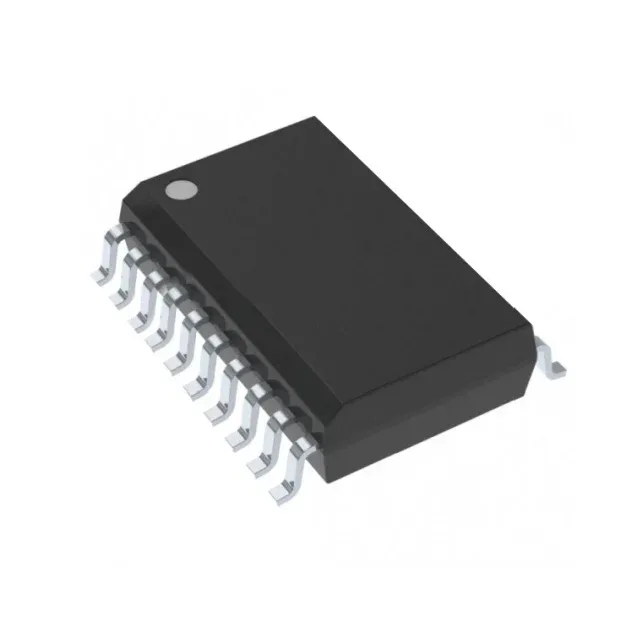
Quad-channel isolator with on-chip isolated power — what it saves on the BOM
The Texas Instruments ISOW7742FDFMR is a general-purpose, quad-channel digital isolator in the ISOW774x family that integrates an isolated DC/DC converter on the same package. That integrated power stage is the headline differentiator: it delivers a regulated output voltage to the isolated side without a separate transformer, rectifier, or LDO, which shrinks the bill of materials and board area for industrial fieldbus interfaces, motor-drive encoder feedback, and isolated SPI or UART links. The part uses capacitive coupling for the signal path and is rated for 5000 Vrms isolation with a data rate of 100 Mbps, making it suitable for high-speed communication across a reinforced insulation barrier. The 2/2 input-to-output channel configuration provides two channels in each direction, which maps cleanly to a full-duplex SPI bus (MISO, MOSI, SCLK, CS) or a pair of bidirectional control signals.
85 kV/µs CMTI — the spec that decides motor-drive survivability
Common-mode transient immunity is the parameter that determines whether the isolator holds data integrity when a high dV/dt event slams the barrier — think an IGBT switching 600 V in tens of nanoseconds. The ISOW7742FDFMR specifies a minimum CMTI of 85 kV/µs. For context, industrial motor drives and inverter stages typically generate common-mode slew rates in the 10–50 kV/µs range, so this part provides healthy margin. The 5000 Vrms isolation rating supports reinforced insulation per IEC 60747-17, which is the usual requirement for mains-connected equipment. Propagation delay is symmetrical at 15.7 ns max for both tpLH and tpHL, and pulse-width distortion is held to 5 ns max. That symmetry matters for clocked interfaces where duty-cycle distortion eats into setup-and-hold margins. Rise and fall times are 2.5 ns and 2.4 ns typical, which keeps the signal edges clean at 100 Mbps without excessive ringing.