5700Vrms isolation in a 16-SOIC — what it buys you
The Texas Instruments ISO7820LLDW is a 2-channel, unidirectional digital isolator built on capacitive coupling technology. Its headline rating is 5700Vrms of isolation, which provides reinforced insulation for industrial drives, medical patient-contact equipment, and grid-tied power converters where a fault must not propagate across the isolation barrier. The 100Mbps data rate handles SPI clock lines, UART signals, and general-purpose GPIO isolation without timing margin issues — the 25ns propagation delay (max) and 4.5ns pulse-width distortion are tight enough for most synchronous interfaces.
100kV/µs CMTI — why it matters for motor drives and inverters
In a variable-frequency drive, the switching node of the IGBT can slew at tens of kV/µs; a lower CMTI isolator would glitch or latch, corrupting the gate-drive or feedback signal. This part holds the data path clean through those edges, which is the difference between a reliable inverter and one that sporadically faults.
The supply range spans 2.25V to 5.5V on both sides, so it works directly with 3.3V or 5V logic without external level shifters. The unidirectional channel configuration — 2 inputs on side 1, 0 on side 2 — means it is a fixed-direction isolator; ideal for isolating sensor outputs or control signals that flow one way, not for bidirectional buses like I²C.
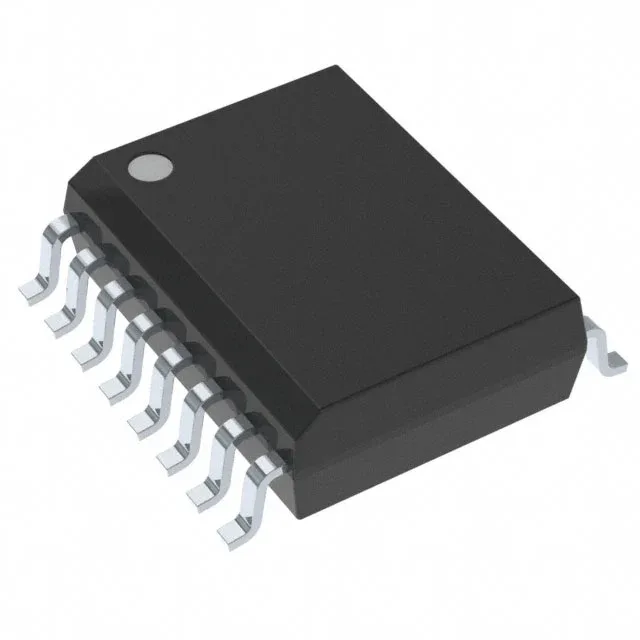
The 16-SOIC wide-body package (7.50mm width) provides the creepage distance needed to maintain the 5700Vrms rating across the board.