Six-channel CAN isolator for automotive and industrial buses
The Texas Instruments ISO7762FQDBQQ1 is a six-channel, unidirectional digital isolator built with capacitive coupling technology, specifically characterized for CAN bus isolation in automotive and industrial applications. The part delivers 3000 Vrms isolation with a minimum common-mode transient immunity of 85 kV/µs, which keeps data integrity in noisy inverter environments. The 4/2 input-to-output channel split matches the typical CAN controller side (four inputs) to the transceiver side (two outputs), with the remaining channels available for status or enable signals.
The 100 Mbps data rate supports CAN FD (flexible data-rate) frames at the full arbitration and data phase speeds, so this isolator does not become the bottleneck in a high-throughput CAN FD network. The 16 ns maximum propagation delay in both directions keeps the loop delay well within the CAN bit-timing budget, even when accounting for the transceiver and connector delays. Pulse-width distortion is held to 4.9 ns max, which preserves the duty cycle of the CAN signal through the isolation barrier — important for accurate sampling at the receiver. The 1.1 ns typical rise and 1.4 ns fall times are fast enough for 100 Mbps signaling but not so aggressive that they cause excessive ringing on a well-terminated bus.
Supply range and logic-level compatibility
The unidirectional channel architecture is intentional for CAN isolation: the controller-side inputs (Side 1) drive the isolator outputs (Side 2) toward the transceiver, and the transceiver-side outputs (Side 2) feed back to the controller inputs (Side 1) — the 4/2 split matches this exactly. No internal DC-DC converter is included, so an isolated power module or separate supply rail is needed for the secondary side.
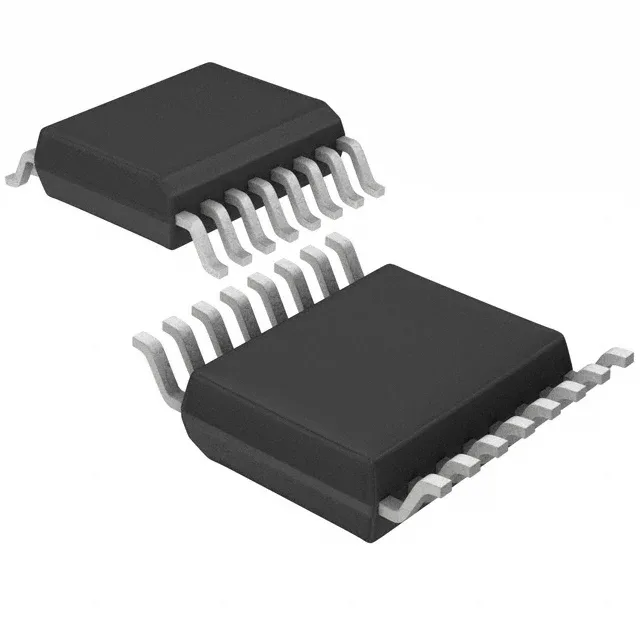
Surface-mount with a pitch that is well within the capability of any modern pick-and-place line. The supplier device package is 16-SSOP, so the same footprint works across the ISO7762 family.
For dual-sourcing resilience, the base product number ISO7762 covers multiple channel-count and direction variants — the FQDBQQ1 suffix denotes the 6-channel unidirectional configuration in the 16-SSOP package with automotive qualification.