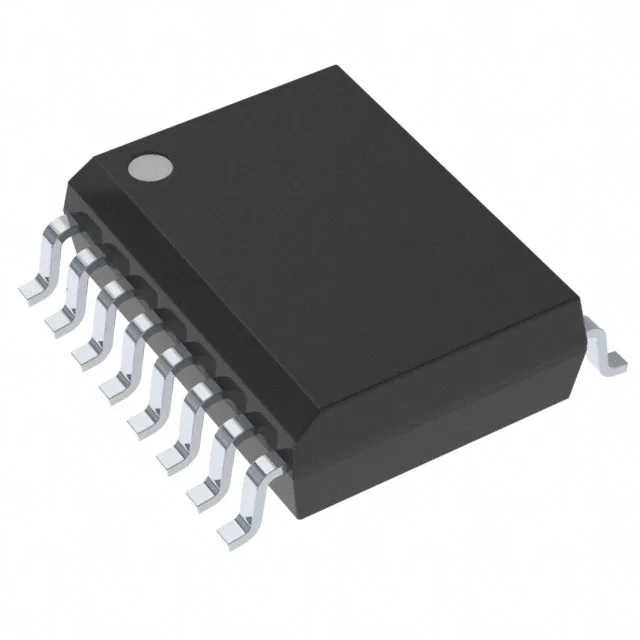
The Texas Instruments ISO7762FDWR is a 6-channel digital isolator in the ISO776x family, built on capacitive coupling technology. It provides unidirectional signal isolation across a reinforced 5000 Vrms barrier, with a data rate of 100 Mbps and propagation delay of 16 ns max per channel.
85 kV/µs CMTI — the margin that matters in noisy environments
In a motor-drive or solar-inverter application, fast switching edges on the high-voltage side can couple several kilovolts per microsecond across the barrier. If the isolator's CMTI is too low, those edges corrupt the output data — a glitch that can trip a gate driver or misread a sensor. The 85 kV/µs figure gives enough headroom for most 600 V to 1200 V SiC and IGBT switching stages, even with parasitic capacitance in the layout.
4/2 channel split and 1.1 ns rise time
The channel configuration is four inputs on side 1 and two on side 2 — a common pattern for isolating an SPI bus (SCLK, MOSI, MISO, CS) plus one or two control signals. Rise and fall times are 1.1 ns and 1.4 ns typical, so the edges are fast enough for 100 Mbps NRZ data without excessive ringing, provided the PCB trace length stays under a few inches. Pulse-width distortion is held to 4.9 ns max, which keeps the duty-cycle error small enough for most PWM or serial protocols.