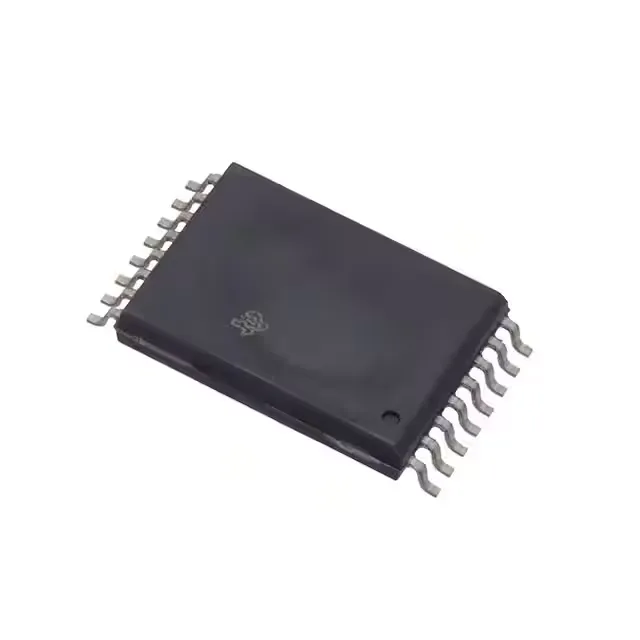
Reinforced isolation for the automotive power train
It delivers 5700 Vrms of isolation voltage — enough for reinforced isolation in 400 V and 800 V battery systems — and sustains a 100 Mbps data rate across the isolation barrier. The 16-SOIC wide-body package (14.00 mm width) provides the creepage distance needed for basic and reinforced isolation classes in on-board chargers, traction inverters, and BMS communication links.
85 kV/µs CMTI — why it matters for motor-drive feedback
The 85 kV/µs minimum common-mode transient immunity is the spec that keeps the data path intact when a SiC or IGBT power stage switches at high dv/dt. In a traction inverter, the isolated gate driver's feedback path (desat detection, current sense) sees common-mode voltage swings of several hundred volts in tens of nanoseconds. If the isolator's CMTI is too low, the output toggles falsely and the controller sees a phantom fault. At 85 kV/µs the ISO7741QDWWQ1 comfortably handles the worst-case edge rates from modern wide-bandgap devices.
Supply flexibility and channel mapping
The channel configuration is 3 inputs on side 1 and 1 input on side 2, all unidirectional. That maps naturally to a three-channel SPI bus (SCK, MOSI, CS) plus one reverse-channel (MISO) for isolated sensor readback or gate-driver fault reporting. Propagation delay is 16 ns max in both directions, with pulse-width distortion held to 4.9 ns max, so the timing budget for a 25 MHz SPI link stays clean.
Temperature grade and package for the engine bay
The 16-SOIC wide-body (0.551" body width, 14.00 mm lead span) provides the 8 mm+ creepage that reinforced isolation standards (IEC 60747-17, VDE 0884-11) require at the working voltage of a 400 V traction system.
It is the wide-body, automotive-grade variant of the ISO7741 family, sharing the same base functional specification as the industrial-grade ISO7741DW.