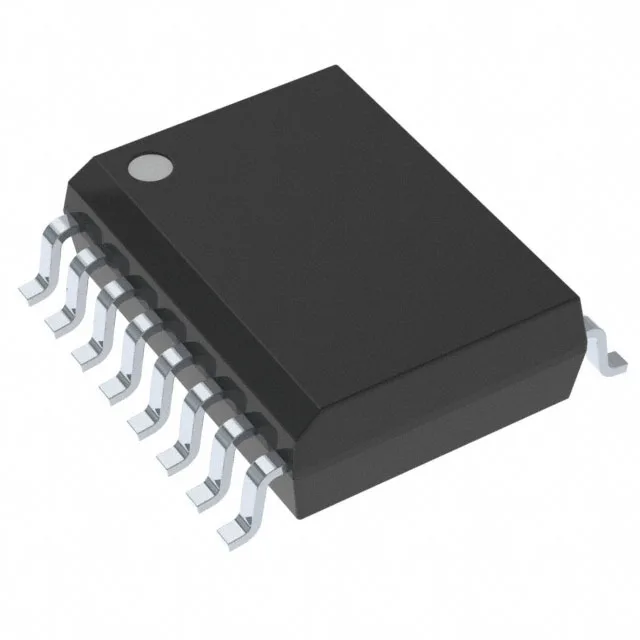
What this isolator brings to the board
This variant carries the Q1 suffix, meaning it is AEC-Q100 qualified for automotive applications.
The 100Mbps data rate is fast enough for most isolated SPI buses (up to 50 MHz clock) and parallel GPIO links. Propagation delay is 16ns max with pulse-width distortion at 4.9ns max, so timing margin is tight but workable for 50 MHz serial clocks — budget the delay in your setup/hold analysis. Common-mode transient immunity (CMTI) is a minimum of 40kV/µs. In motor-drive or inverter applications where the ground plane jumps several hundred volts in nanoseconds, this rating ensures the output doesn't glitch. If your system sees faster transients, you need a higher-CMTI isolator. Supply voltage range is 2.25V to 5.5V, so the part works on both 3.3V and 5V rails without a separate level shifter. The 3/1 input-side/side-2 channel configuration gives three channels from the primary side to the secondary, and one reverse channel — useful for a combined SPI (SCLK, MOSI, CS) plus MISO return. The 16-SOIC wide-body package with 7.50mm body width provides the creepage distance needed for 5000Vrms reinforced isolation. Check your PCB footprint — this is not the narrow SOIC-8 used by lower-voltage isolators.