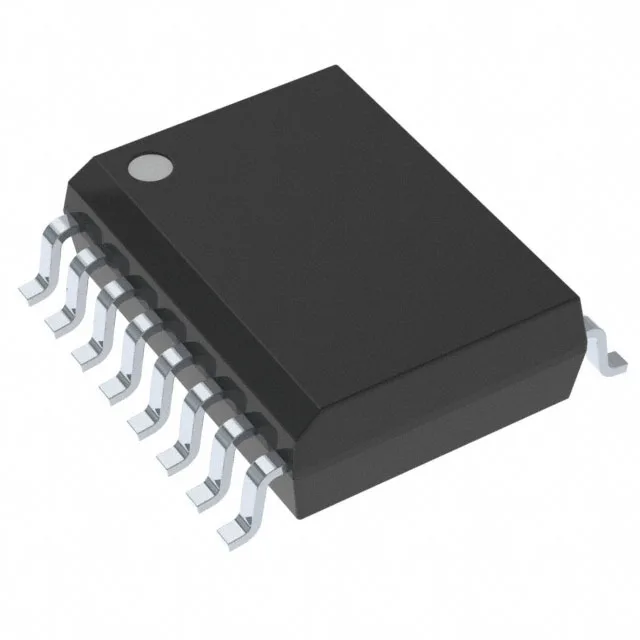
5000 Vrms reinforced isolation — the headline rating
The TI ISO7741FDWR is a 4-channel, unidirectional digital isolator using capacitive coupling to pass signals across a reinforced isolation barrier rated at 5000 Vrms. That isolation voltage is the primary spec that decides fit: it qualifies the part for medical equipment (patient-contact isolation), motor-drive interfaces, and industrial fieldbus where the safety standard demands reinforced insulation rather than basic.
100 Mbps data rate and channel mapping
With a 100 Mbps data rate, 16 ns max propagation delay, and 4.9 ns max pulse-width distortion, this part handles SPI clocks up to 50 MHz (double-edge) and full-speed UART without timing margin trouble. The 3/1 channel split — three forward, one reverse — maps directly to a three-wire SPI bus (SCLK, MOSI, CS forward; MISO reverse) or a UART with RTS/CTS flow control. The unidirectional channel architecture means each channel's direction is fixed at the factory; there is no software-configurable direction toggle, so the board layout must match the 3/1 assignment.
85 kV/µs CMTI — surviving the switching node
Fast-switching SiC or GaN FETs can couple several hundred volts per microsecond across the barrier; if the CMTI is too low, the output toggles falsely. The 85 kV/µs rating here is high enough for most industrial drives and EV traction inverters. The 2.4 ns typical rise/fall time also keeps the signal edges clean at the receiver side, reducing radiated emissions risk.
Supply flexibility and no isolated power
The supply range spans 2.25 V to 5.5 V on both sides independently, so the isolator can bridge a 3.3 V MCU domain to a 5 V peripheral bus without a level shifter. Note the "Isolated Power: No" flag in the specs — this device does not generate a secondary-side supply; each side needs its own local rail. That is typical for capacitive-coupling isolators in this class; if the design needs a single-supply solution with an integrated DC/DC, look at the ISO7741 family's sibling with the 'E' suffix.
Active lifecycle — no end-of-life clock ticking
No other parametric difference between the two.