What the 100 Mbps and 5000 Vrms ratings mean for your isolation barrier
It is a general-purpose device, meaning it handles logic-level signals without encoding or protocol overhead — just pass the digital state straight through. The headline numbers are the 100 Mbps data rate and the 5000 Vrms isolation voltage. The 100 Mbps rating is fast enough for SPI clock lines up to 50 MHz (half-duplex) or full-duplex links like isolated CAN transceivers; if you are running a 10 MHz SPI bus, this part gives you plenty of timing margin. The 5000 Vrms isolation is the reinforced rating for medical equipment (patient-contact isolation), industrial motor drives with 480 VAC rails, and grid-tied power converters where the safety barrier must hold off transient surges.
Temperature range and CMTI — where this part lives comfortably
At 85 kV/µs minimum, this part handles most modern power-stage edges without false triggering. The propagation delay is 16 ns max (both directions), and pulse-width distortion is 4.9 ns max — tight enough for 100 Mbps NRZ data with a 10 ns bit period.
Channel assignment and supply flexibility
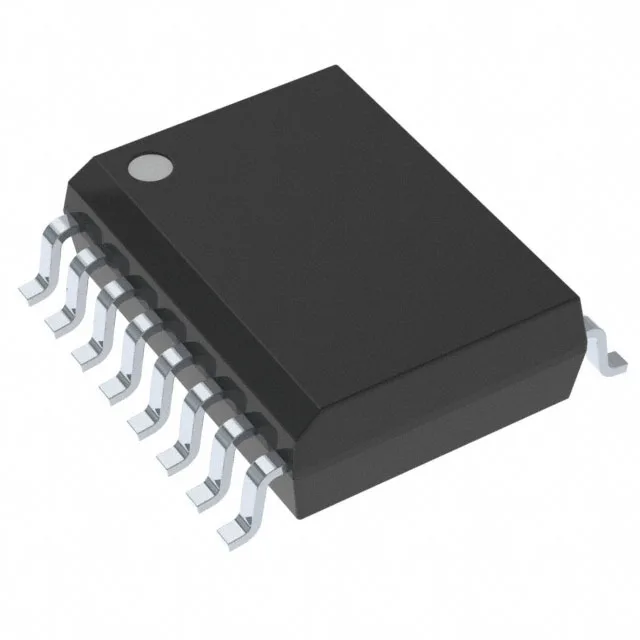
The four channels are arranged as three on side 1 and one on side 2 (3/1 configuration). That is a common pattern for isolating an SPI bus: three lines from the controller to the peripheral (SCLK, MOSI, CS) and one line back (MISO). The unidirectional channel type means each channel drives in one direction only — no bidirectional data lines like I²C without external direction control. The part does not include an integrated isolated DC-DC converter (isolated power is listed as No), so each side needs its own supply rail. The wide-body 16-SOIC package (7.50 mm width) provides the creepage distance needed for the 5000 Vrms rating.