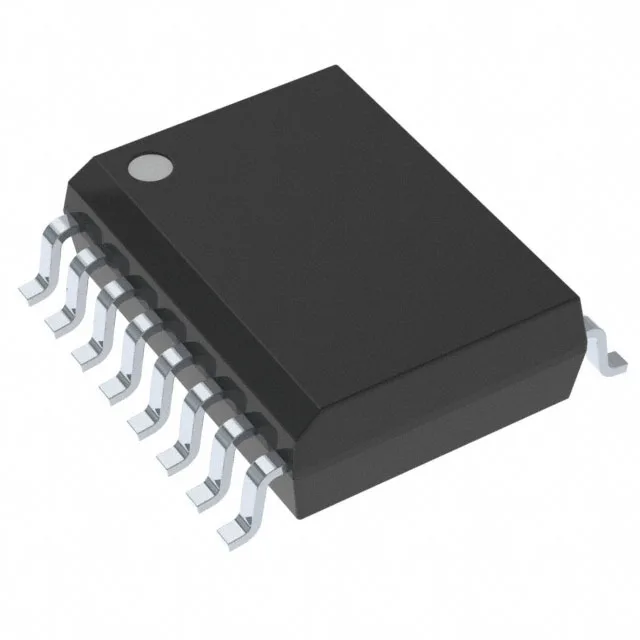
Automotive-grade isolation for harsh environments
The device provides 5000 Vrms isolation voltage and a minimum common-mode transient immunity of 85 kV/µs, which is essential for maintaining signal integrity in the presence of fast-switching GaN or SiC power stages. The unidirectional channel configuration — three channels on side 1, one channel on side 2 — fits common SPI, UART, and GPIO isolation patterns where the primary-side microcontroller sends data across the barrier to a secondary-side peripheral.
100 Mbps signaling with tight timing margins
With a maximum propagation delay of 16.5 ns and pulse-width distortion limited to 4.9 ns, the ISO7741EDWQ1 supports reliable data transmission at 100 Mbps. The 2.4 ns typical rise and fall times keep the signal edges clean enough for clocked interfaces like SPI at 50 MHz, though the 16.5 ns propagation delay means the designer should budget for that latency in the timing closure analysis — especially in daisy-chained isolation paths where delays accumulate. The device does not include an integrated isolated DC-DC converter, so a separate isolated power supply is required for the secondary side.
Package and footprint for production assembly
The wide SOIC footprint is a standard industry format for high-voltage isolators, so PCB layout reuse across multiple isolator vendors is straightforward.
For dual-sourcing flexibility, the base product number ISO7741 family includes multiple channel configurations and temperature grades — the E-grade suffix denotes the automotive -40°C to 150°C range, while the DWQ1 suffix specifies the 16-SOIC package with AEC-Q100 qualification.