Three-channel unidirectional isolation for automotive signal chains
It provides 5000Vrms galvanic isolation across the barrier, with two channels on side 1 and one channel on side 2.
100 Mbps data rate and timing margins
Rated for 100 Mbps, this isolator handles SPI clock rates up to 50 MHz (double-edge) and general-purpose digital signals comfortably. The 16 ns max propagation delay in each direction and 4.9 ns max pulse-width distortion mean the timing budget for a 50 MHz SPI bus leaves roughly 4 ns of margin after accounting for driver and receiver delays — enough for most automotive sensor interfaces but worth checking against the specific controller's setup/hold requirements.
85 kV/µs CMTI — built for noisy power environments
Common-mode transient immunity of 85 kV/µs minimum means this part reliably passes data across the isolation barrier when adjacent power stages are switching at tens of kV/µs — typical in traction inverters, DC-DC converters, and motor drives. The 1.3 ns typical rise and 1.4 ns fall times keep signal integrity clean even with fast edges, reducing radiated emissions concerns in EMC testing.
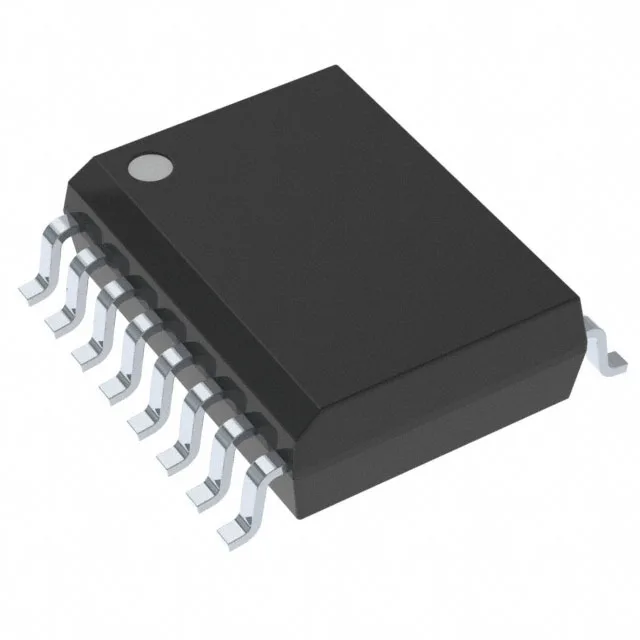
Package and footprint: 16-SOIC wide-body
Automotive temperature range and qualification
The base product number ISO7731 covers multiple channel-direction and output-default variants sharing the same 16-SOIC footprint, simplifying second-source qualification within the family.