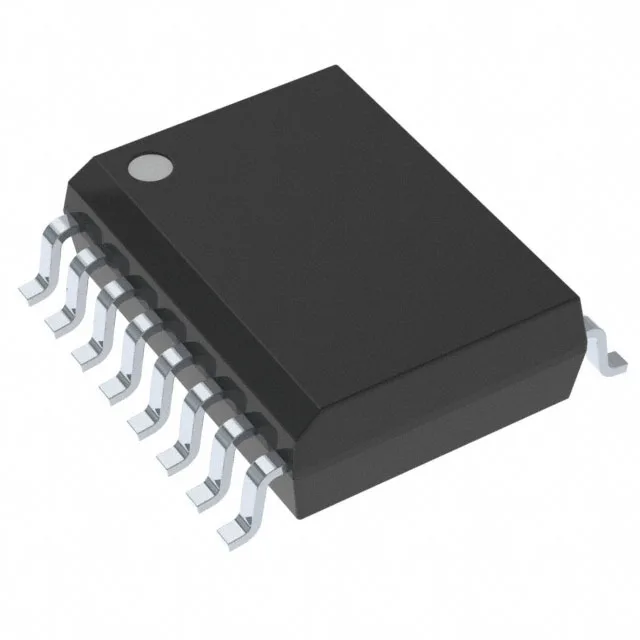
5000 Vrms isolation — the safety-barrier spec that decides fit
Its headline rating is 5000 Vrms isolation voltage, which qualifies it for reinforced insulation in mains-connected industrial and medical equipment where a safety barrier is required between the high-voltage and low-voltage domains. The part supports a 100 Mbps data rate, matching the throughput of common serial buses like SPI, UART, and CAN FD without adding latency.
85 kV/µs CMTI — why it holds up in motor drives and inverters
In a motor-drive or solar-inverter environment where IGBT or SiC switching edges produce fast voltage transients across the isolation barrier, a low CMTI part can falsely toggle its output. This rating means the ISO7731FDW maintains data integrity through those events. Propagation delay is symmetrical at 16 ns max for both low-to-high and high-to-low transitions, with pulse-width distortion held to 4.9 ns max — tight enough for timing-sensitive interfaces like isolated SPI clock lines.
3-channel unidirectional — 2 forward, 1 reverse
The channel configuration is 2 inputs on side 1 and 1 input on side 2, all unidirectional. This suits applications where two data lines cross the barrier in one direction (e.g., TX and clock from a controller to a peripheral) and one line returns in the opposite direction (e.g., RX or fault feedback). The part does not include an integrated isolated DC-DC converter — isolated power must be supplied externally.