Isolation barrier and speed — what 5000 Vrms and 100 Mbps mean for the design
It provides reinforced isolation rated at 5000 Vrms, making it suitable for applications requiring a robust safety barrier, such as industrial motor drives, grid-tied inverters, and medical equipment where galvanic isolation between high-voltage and low-voltage domains is mandatory. With a data rate of 100 Mbps and propagation delays of 16 ns max in both directions, this part handles high-speed digital signals like SPI, UART, or CAN without introducing significant timing skew. The 1.3 ns typical rise/fall times keep signal edges clean enough to avoid excessive EMI, but the fast edges also mean the layout needs care — keep the isolation barrier clear of noisy traces and place the supply decoupling close to the pins. If the power stage runs slower (IGBTs at a few kHz), the margin is generous; the CMTI number matters most when the switching edge is sharp.
Supply rails and channel configuration
The ISO7731BDW operates from 2.25 V to 5.5 V on both sides, so it can bridge a 3.3 V MCU domain to a 5 V peripheral or sensor interface without a level shifter. The supply range also covers 1.8 V logic at the low end (though 2.25 V minimum means 1.8 V logic needs a translator), and 5 V tolerant inputs on the high side. Channel assignment is 2 inputs on side 1, 1 input on side 2 — unidirectional only. That is a common configuration for isolating a two-wire SPI (SCLK, MOSI) from the controller side and a single MISO feedback line from the peripheral. If bidirectional signals (e.g., I²C SDA) are needed, this part does not support them; a different isolator with directional control or a dedicated I²C isolator would be required.
Temperature range and package — environment fit
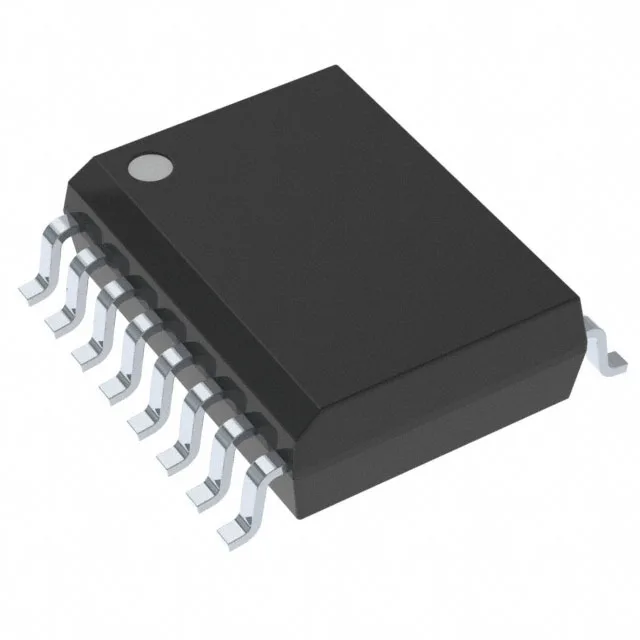
The 16-SOIC wide-body (7.50 mm width) package provides the creepage distance needed to maintain the 5000 Vrms isolation rating across the PCB — standard SOIC-8 narrow-body would not meet the clearance.