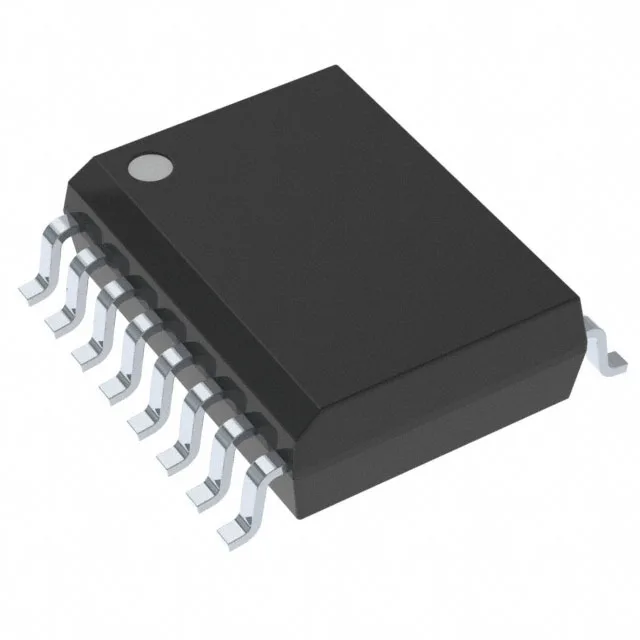
What this 3-channel capacitive isolator covers
The TI ISO7631FCDW is a general-purpose digital isolator using capacitive coupling to pass signals across a 2500 Vrms isolation barrier. Its three unidirectional channels — two on side 1, one on side 2 — handle data rates up to 25 Mbps with a typical propagation delay of 28 ns and pulse-width distortion held to 3 ns max.
25 Mbps timing budget — what the 28 ns prop delay buys you
At 25 Mbps the bit period is 40 ns, so a 28 ns propagation delay consumes about 70% of the period before the receiver even sees the edge. That leaves roughly 12 ns of timing margin for the rest of the signal path — the driver's output rise/fall (2.8 ns, 2.9 ns typical), PCB trace skew, and the receiver's setup/hold. For a 10 MHz SPI clock the margin is comfortable; pushing toward 25 Mbps means the layout needs controlled impedance and matched trace lengths to avoid losing the setup window. The 3 ns max pulse-width distortion means the on-chip timing skew between the rising and falling edges stays tight — important for PWM signals or any protocol where duty-cycle fidelity matters. If you are isolating a 25 kHz PWM for a motor drive, the distortion adds less than 0.03% duty-cycle error.
CMTI and isolation — staying alive in a noisy environment
That transient couples through parasitic capacitance across the isolation barrier; the capacitive coupling technology in this part handles it without the LED-drive current that an optocoupler would need to maintain its CTR. The 2500 Vrms isolation is rated for basic or reinforced isolation per IEC 60747-17, sufficient for mains-connected industrial equipment. At the high end, keep in mind that propagation delay typically increases with temperature — budget an extra 10-15% for timing closure above 85°C.
For production BOMs that need a second source, the ISO7420FEDR is a 2-channel unidirectional alternative with a higher 50 Mbps data rate and similar 2500 Vrms isolation — but it drops one channel, so the channel count difference rules it out for a 3-channel design without a board spin.