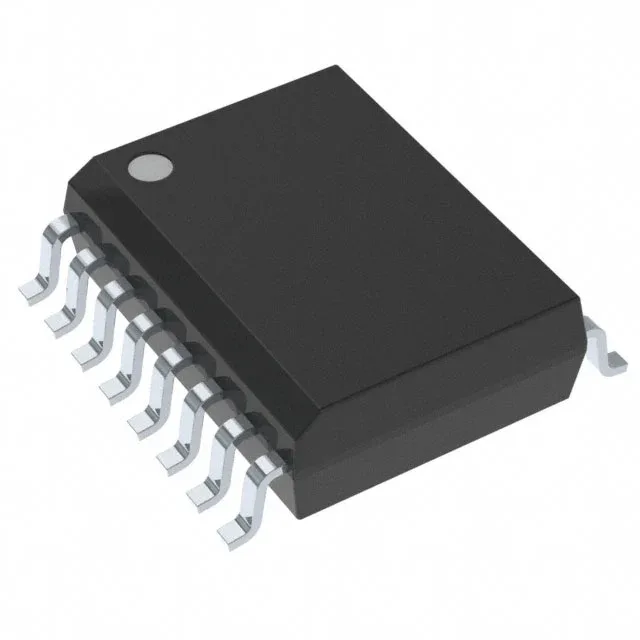
Two-channel capacitive isolator for industrial signal isolation
The Texas Instruments ISO7520CDWR is a general-purpose digital isolator built around capacitive coupling technology, providing galvanic isolation for two unidirectional channels in a single 16-SOIC wide-body package. It supports a data rate up to 1 Mbps and delivers a rated isolation voltage of 4243 Vrms, with a minimum common-mode transient immunity of 25 kV/µs.
The 1 Mbps data rate is the maximum signalling speed this part can sustain. If your application runs SPI at 10 MHz or a CAN FD bus at 5 Mbps, this isolator will bottleneck the link. It is sized for UARTs at 115.2 kbps, I²C at 400 kHz, or general-purpose GPIO isolation where the signal rate stays under 1 Mbps. The propagation delay is a symmetrical 14 ns max in both directions, and pulse-width distortion is held to 3.7 ns max, so edge symmetry is tight enough for most asynchronous serial protocols at this speed.
Isolation rating and transient immunity for motor-drive environments
With 4243 Vrms of isolation and a minimum common-mode transient immunity (CMTI) of 25 kV/µs, the ISO7520CDWR is rated to withstand the high dv/dt events common in motor-drive inverters, industrial power supplies, and solar inverters. The CMTI floor of 25 kV/µs means the output will not glitch when a fast common-mode step—like a switching node transition—couples across the isolation barrier. This is the spec that determines whether the isolator holds its state through a hard-switching event. The rise and fall times are a fast 1 ns typical, which keeps the edge sharp but also demands careful PCB layout to avoid coupling noise back into the input side.
Supply rails and unidirectional channel configuration
The channel arrangement is 2 inputs on side 1 and 0 inputs on side 2—meaning both channels drive from side 1 to side 2. This is a purely forward-direction isolator; there is no reverse channel. If you need bidirectional isolation (e.g., for an RS-485 transceiver interface), you would need a part with at least one reverse channel or use two of these back-to-back.